Showing posts with label science. Show all posts

Wednesday, 3 August 2011

If wishes were horses...

I've talked about animal experimentation before (e.g. here and here) but I was pointed to this discussion on the Guardian website:

Dr Sebastien Farnaud of the Dr Hadwen Trust and Prof Roger Lemon of UCL debate the ethics and uses of tests on monkeys

The opening piece by Dr Farnaud contained so many anti-vivisection tropes I was moved to repeat it here (with my comments):
"I thank you very much for giving me the opportunity to start this discussion about a very controversial matter, the validity of the use of non-human primates in medical research, a subject in which, as a medical research charity, the Dr Hadwen Trust is particularly interested."
No, the Dr Hadwen Trust was set up specifically to oppose animal research.
"The first thing to consider is the aim of the Bateson report, which has just been published, its standpoint and who wrote it.
This report is an independent review commissioned by all the major research funders in the UK, to assess the quality, outputs and impacts of research carried out on non-human primates, and their benefits to human health. This review follows the publication in 2006 of the Weatherall report by a working group chaired by Sir David Weatherall that recommended that the major funding organisations should undertake a systematic review of the outcome of all their research using non-human primates (NHPs) supported over the last decade.
Interestingly, whereas the Weatherall report was unambiguously in favour of the use of NHP in medical research, the Bateson report adopts a more challenging position. Professor Bateson, who is emeritus professor of ethology at Cambridge University and president of the Zoological Society of London, is very well respected within the scientific community.
It is therefore very important that statements in his report, indicating that almost one in 10 research projects that used monkeys in the UK result in no scientific or medical benefit, are not ignored. He also states that the justification for some projects carried out over a 10-year period from 1996 was "inadequate or insufficient" and that future projects involving non-human primates that could not demonstrate plausible medical or social benefits should not be funded."

I think only 1:10 experiments showing no scientific or medical benefit is a surprisingly high proportion  showing benefit. I'd imagine most scientific research is of minimal use, even medical research, and a figure as high as 90% showing benefit is amazing. Justification for most experiments, when considered outside the narrow question of what people in a particular scientific field think is interesting, is generally poor anyway. So again, I see little to criticise primate experiments over any other area of science.
"The reviewers also reported the unnecessary and unjustified repetition of work published a decade earlier."
To be fair, there are plenty of reasons to repeat experiments done a decade earlier, including replicating a study to show that the effect is robust and repeatable, and verifying that you are performing a particular technique correctly by reproducing a know effect so you can then go on to develop that further.
"These points underline that the issue is not simply an ethical issue but also a scientific one. This simply questions the scientific validity of NHP use in medicine."

No it doesn't. 10% does not equal 100%.
"The report recommends the promotion and development of alternatives to the use of NHP in research."
Well, duh! I imagine 'mom and apple pie' also get a mention.
"Since most diseases studied in NHP are human diseases that do not naturally occur in NHPs, it seems logical to try to develop models which are from the start human-relevant. Here we have to make clear that nobody is proposing we use invasive methods on human subjects. On the other hand, advanced techniques, which were barely mentioned in the Weatherall report, are highlighted in the Bateson report.. These techniques include, for example, magnetoencephalography (MEG) and transcranial magnetic stimulation (TMS), non-invasive imaging techniques that are already in use to help us understand diseases and the needs of patients who suffer from neurological disorders. Organisations such as the Dr Hadwen Trust have promoted and funded these techniques for over a decade."

Yeah, because if fMRI doesn't have the anatomical resolution then MEG or TMS are going to do the trick. If wishes were horses...
"One very important point that the report makes concerns regulation. It emphasises the importance of and the need for a robust system of regulation for animal experiments, at a time when the Home Office is preparing the implementation of the new EU directive for the protection of animals used for scientific purposes."
Good job UK regulation is the tightest in he world (which is not to say it doesn't focus excessively on process and paperwork rather than welfare).
"To conclude I would say that although this report will not please everybody, I like to believe that it is a first step towards major changes, a different attitude that will challenge the use of NHPs in medical research."
Indeed.

Tuesday, 25 January 2011

The Academic-Medical Establishment

I was at a talk recently regarding the side-effects of a widely used drug, let us call it 'fictoxetine'. Now fictoxetine has long been thought to cause damage to the body, let us say the retina, leading to progressive visual loss and eventually blindness. Fictoxetine can be used for years, even decades, and so patients need to have their vision screened regularly. This talk reported their findings from a systematic review and meta-analysis that sought to find out whether the evidence actually supported this fear.

What they presented was data showing that over 1-2yrs of fictoxetine use visual acuity declined by around 10%. They also reported evidence that found that rates of fictoxetine use in people on a register of blind people were around twice those in the general population. They then concluded from this that fictoxetine doesn't really have as much of a major effect on vision as we had thought so we shouldn't be so worried about it and pontificated on how this myth had become so widespread in the medical community.

The majority of people at that talk took this message at face value and went away with that in their heads, maybe they will change their clinical practice - after all a respected academic in the field of fictoxetine research presented the evidence that showed fictoxetine doesn't have much effect on vision. Didn't he?

Well no, he didn't, the data I've just described is consistent with fictoxetine having really quite a large and serious effect on vision. If the short-term deficits of 10% in acuity over 1-2yrs continued over 10 years that would be a major loss of 40% of visual acuity. The blind register data is neither here nor there, most people would stop fictoxetine in patients with significant visual loss in the hope that they would never reach complete blindness (conversely, maybe they would be more happy to start it in people who were already completely blind than those with some vision).  So the data doesn't support the narrative being given to it but few people feel qualified or confident to gainsay a big name in the field.

And this is true throughout academic medicine, and academia in general, powerful personalities are able to shape the discourse in a scientific field not only through the research they perform but also the wider influence their ideas and opinions carry.

Thursday, 6 January 2011

Lamotrigine: an exciting new treatment for acute bipolar depression?

I've talked a fair bit about the efficacy of antidepressants (or lack thereof) in treating major depression. I won't go into that again, but I did want to discuss something that has been neglected in that debate.

Bipolar depression
It's estimated that some 10% of people with a major depressive episode have underlying bipolar disorder - that is they'll go on to have a manic or hypomanic episode (if they haven't had one already) - and if the efficacy of antidepressants in straight major depression is controversial then bipolar depression is a minefield.

It is certainly considered that antidepressant usage alone gives a big risk of provoking a swing from a depressive to a manic episode so they would usually be used alongside a 'mood stabiliser' like lithium or an anticonvulsant, and even then there is considerable disagreement as to how much they help.

Lamotrigine in acute bipolar depression
Something that has got a lot of attention in recent years is the anticonvulsant lamotrigine. There is good evidence for the efficacy of lamotrigine in preventing further depressive episodes in people with bipolar disorder. But recently there has been much interest in its use for treating an acute episode of depression in bipolar disorder, and this is despite the fact that it takes a considerable time to titrate up the dose to therapeutic levels (if you go by the BNF it takes 5 weeks to get to the usual dose of 200mg).

A major paper influencing people's thinking came out of Oxford by Geddes et al in 2009. This was a meta-analysis of trials of lamotrigine in acute bipolar depressive episodes and had a considerable impact. The Canadian Network for Mood and Anxiety Treatments (CANMAT) guidelines now recommend lamotrigine as a first-line treatment for acute bipolar depression largely on the strength of this analysis.

What they did was, apparently, contact GSK (who make lamotrigine as 'Lamictal') and get hold of all the individual patient level data from all five trials performed by the drug company and used it to perform a meta-analysis. They also identified two other studies not by GSK but didn't combine them because they didn't have any individual subject data and the trials were a crossover trial (which is difficult to correctly combine in a meta-analysis) and the other used lamotrigine as add-on to lithium therapy. They excluded data from one of the trials which had used a 50mg dose as this is generally considered subtherapeutic.

I'll concentrate on their findings using the Hamilton Rating Scale for Depression (HRSD, 17-item version) which is very widely used in antidepressant trials (I've mentioned it before) which has a maximum of 54 points and a score greater than 18 is usually needed to be recruited into a trial as 'moderately' depressed. Again, I'll focus on two measures of outcome, 'response rate' (the proportion of patients in each arm who achieve a 50% or more reduction in their initial HRSD score) and mean difference in the final HRSD score.
If we look at the mean difference in the final HRSD score (this was adjusted for baseline severity in a regression) it was –1.01 (–2.17 to 0.14). That mean difference is not statistically significant (although using a different measure, the Montgomery–Åsberg Depression Rating Scale, they did find a statistically significant effect), nor is it even suggesting a particularly large effect is possible (with the upper limit of the effect size around 2 points on the HRSD). This is smaller than the 1.8 point effect size reported by Irving Kirsch's meta-analysis of 'new' antidepressants in major depression and when I reanalysed Kirsch's data properly I (and others) found an effect size of 2.7 points on the HRSD, just short of NICE's (arbitrary) 3 point threshold for 'clinical significance'.

So a mean improvement of 1.0 points on the HRSD is not exactly impressive - certainly it wouldn't be very good if that was a uniform single point improvement across every patient. But potentially it could represent a really big, 'clinically significant' improvement for a subset of patients - and we'd be interested in a drug that could do that.

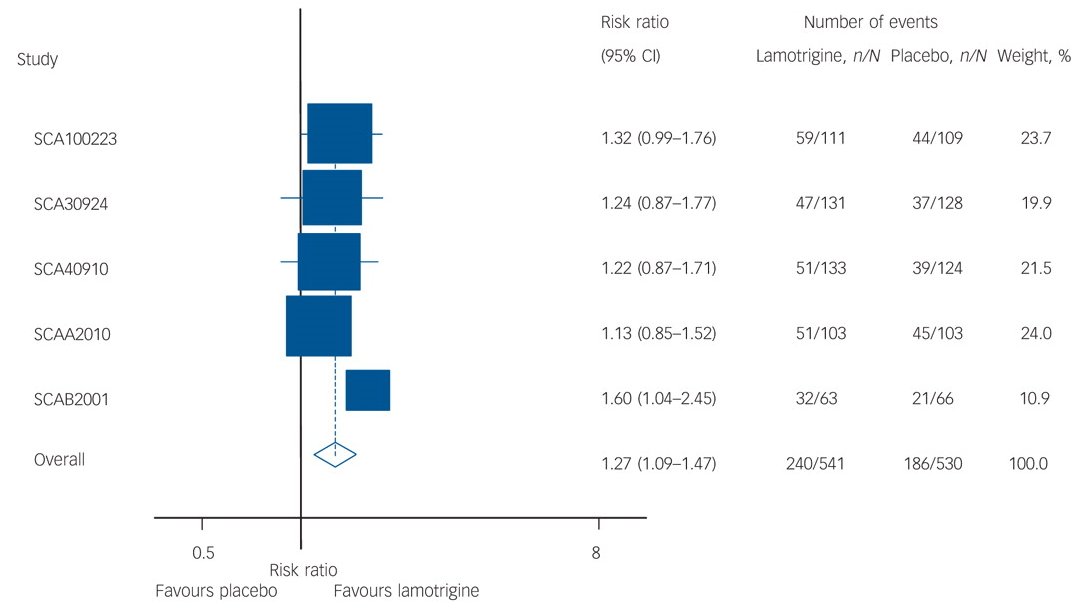
So this is why we look at 'response rates' - what proportion of patients got 'clinically significantly' better, or 'remission rates', the proportion who score sufficiently low to count as being better. Commonly the former is defined as a 50% reduction in the score on the HRSD (or other symptom scale). We can see below (Figure 1) that significantly more patients responded in the lamotrigine group than the placebo group with a risk ratio of 1.27 (95% CI: 1.09-1.47), that is 27% more patients in the lamotrigine group showed an improvement in HRSD of 50% or more - that implies 11 patients need to be treated for one additional 'response'.

Figure 1. Figure from Geddes et al - Meta-analysis of HRSD 50% response rates using individual patient data from GSK trials
As has been pointed out before, response rates in depression trials are slippery beasts. By calling a 50% reduction in HRSD score a 'response' to treatment you actually need to improve by less points on the HRSD if you are less depressed (and have a lower baseline score) so an improvement on exactly the same items of the HRSD could be classified as 'response' or 'no response' depending on that patient's initial severity. This also means that this measure is very vulnerable to small differences in baseline severity between the arms of a trial.*  In practice response rates based on thresholding continuous variables like the HRSD (such as a 50% improvement threshold, or a threshold of 8 points for 'remission') are vulnerable to artefactual non-linear effects where very small improvements tip a few people over the threshold (something to particularly worry about if the threshold used seems a bit arbitrary anyway as you can easily pick one after the fact that amplifies any effect).  

The response rates in this study are around 35% of patients in the placebo arm and 45% of those taking lamotrigine - so an increase of 10 percentage points due to lamotrigine. If we consider that, for the average patient, 50% improvement implies a minimum change of around 12 points on the HRSD the actual mean improvement of 1.0 points (and the standard deviation) seems a little small (in a back of the envelope calculation you could say that you would expect an average of 1.2 point improvement - thats 10% getting 12 points averaged over all the group). So a bit of a mixed bag I'd say.

Traditional meta-analysis versus individual patient data
A question that occurs to me is what extra information we gain from having the individual patient data? It is pretty rare to get hold of individual patient data when doing a meta-analysis, usually all we have is the overall results for each trial. Sometimes this doesn't make much difference, comparing the individual level meta-analysis by Fournier et al of antidepressants with Kirsch et al's meta-analysis did not reveal any major differences (and these studies looked at fairly different sets of antidepressants).

I had a quick go at performing a study level meta-analysis of the GSK lamotrigine data** and found that the response rate had a relative risk of 1.22 (1.06-1.41) (Figure 2 below) which is pretty similar to the individual level data 1.27 risk ratio.

Figure 2. Meta-analysis of HRSD 50% response rates from GSK per trial data
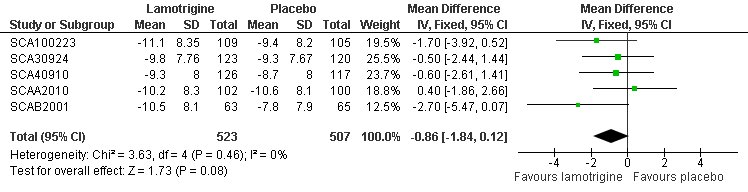
Looking at the mean difference in the change in HRSD scores I found an effect size of -.86 points (-1.84-.12) which is similar to the -1.0 effect using individual level data and is similarly also only borderline statistically significant (Figure 3 below).

Figure 3. Meta-analysis of mean difference in HRSD scores from GSK per trial data
This is pretty reassuring as it suggests the majority of the information is present in the trial data so we wouldn't lose too much or miss any important effect if we didn't have the individual patient data available. You have to ask why GSK didn't re-analyse the data themselves, this would have been easily done (it took me a few minutes). I think there are a few reasons for this, one intimated in the paper is that regulatory authorities do not accept the results of meta-analyses, they require two large positive trials for licensing a drug, and all but one of the GSK trials was negative so a meta-analysis would have done them no good with licensing. However, they could still have influenced the scientific literature or provided justification for a further larger trial and I wonder whether they didn't in fact do the same analysis as either me or Geddes et al and realise that this was probably a small and fairly dubious effect and reckon it wouldn't do them any favours in the long run.

Antidepressant response and the severity of depression
Like many previous studies of antidepressants Geddes et al also find that there is an interaction between the size of the antidepressant effect of lamotrigine and how severely depressed the patients in the study were at baseline. They found a significant interaction on their ANCOVA analysis between baseline HRSD severity and final HRSD score with a regression coefficient of .30 (p=.04). They go on to comment that:
"Thus, the interaction by severity was because of a higher response rate in the moderately ill placebo-treated group, rather than, for example, a higher response rate in the severely ill lamotrigine-treated group."
This statement is very redolent of Kirsch et al's claim:
"The relationship between initial severity and antidepressant efficacy is attributable to decreased responsiveness to placebo among very severely depressed patients, rather than to increased responsiveness to medication."
Kirsch et al got a lot of stick for saying this, not least from yours truly, so I was interested in what a set of rather more mainstream figures in the psychiatric world (two Oxford academic psychiatrists and a psychiatrist from the GSK advisory board) were trying to say, and how this relates the Kirsch's work. Maybe I was being unfair to Kirsch?

Kirsch et al argued that the apparent increase in antidepressant efficacy with increasing baseline severity in trials was due to decreasing placebo response in more severe trials (see Figure 4 below). They further argued that this increasing efficacy was therefore only 'apparent' because the response to antidepressant was the same. I've discussed before how, on many levels, it is meaningless to claim that this effect is only 'apparent'. 

Figure 4. Figure from Kirsch et al - Regression of baseline severity against standardised mean difference of HRSD score improvement for antidepressant and placebo groups using per trial data
However, when I re-analysed their data it was their finding of decreased placebo response that was actually only 'apparent', and was due to needlessly normalising the raw HRSD data using the standardised mean difference (see Figure 5 below) and in fact placebo responses remained fairly static with increasing severity while antidepressant responses increased.

Figure 5. Regression of baseline severity against HRSD score improvement for antidepressant and placebo groups using per trial data from Kirsch et al

Of course these correlations are only looking at the average baseline severity between each trial and doesn't tell us whether the relationship between baseline severity and HRSD improvement holds true within each trial for the individual patients in that trial. Fournier et al used individual level data to look at this relationship and found increases in both placebo and antidepressant responses, with the greater gradient in the latter leading to increased efficacy of antidepressants overall (see Figure 6 below) so there is actually not great evidence for a decreased placebo response with increasing baseline severity in straight trials of antidepressants in major depression.

Figure 6. Figure from Fournier et al - Regression of baseline severity against HRSD score improvement for antidepressant and placebo groups using individual patient data

So what did Geddes et al find? Well, unlike Kirsch et al and Fournier et al they primarily looked at response rates rather than mean change in HRSD, obviously you can't have an individual patient's response rate (an individual either does, or does not respond) so they divided the subjects into two groups, those with a baseline severity below 24 points, and those above. They found that only those in the 'severe' severity (>24 point) group had a statistically significant response rate greater than placebo with 46% of those on lamotrigine responding compared to 30% on placebo. In the 'moderate' (<= 24 point) group response rates were 48% for lamotrigine and 45% for placebo. Geddes and others have argued that this increased placebo response at moderate severity is due to something like inflation of baseline severity at trial recruitment (that is doctors subconsciously inflate severity for those around the lower threshold for trial recruitment and they then regress to the 'real' lower score they would have had anyway when assessed blindly as part of the trial while this doesn't happen for the more severe patients).***

Now I've outlined some of my reservations about 50% reduction in HRSD score as a measure of 'response rate' and I don't think that these numbers necessarily show what Geddes et al think it does. Let's consider a simple model of how antidepressants might work, let's say they can be modelled simply by saying that an antidepressant reduces the baseline HRSD score by X HRSD points which is the simple sum of the placebo effect (P) and a 'true' antidepressant effect (A):

X = P + A

Based on this model, as discussed above, we can see how patients in the 'moderate' severity group could be more likely to respond even if X is the same for both severity groups. This is because a lower baseline severity means less HRSD points need to be lost to reach a 50% reduction. If we take this observation it is conceivable that the lower placebo response in the 'severe' group could be, at least partly, due to pure artefact. Given that those treated with lamotrigine in the 'severe' group had a larger response rate than those on placebo you might then go on to posit that maybe P is larger for the more severely depressed patients.

The way we ideally would want to answer this question would be to look at the mean HRSD scores as we did above for the data from Kirsch et al and Fournier et al. The response rate figures alone would still be completely consistent with a relationship like that shown in Figure 5 above and suggest that the claim that "the interaction by severity was because of a higher response rate in the moderately ill placebo-treated group" is false.

Unfortunately Geddes et al don't show the mean HRSD data by baseline severity nor do they report the correlations between mean HRSD score and baseline severity for the lamotrigine and placebo groups separately, either of which might help to answer this question. This is a bit odd as this is one of the main areas where the individual patient data would prove very useful and answer questions that the trial only data cannot. So we'll never know whether they do or don't show that placebo responses are constant, decreased, or increased with greater severity of depression. I've reproduced the data presenting each trial below (Figures 7 & 8) but these can't really answer this question, for that we need the within trial data.

Figure 7. Simple regression of mean baseline severity against 50% response rates from GSK per trial data split by lamotrigine (blue) and placebo (red)

Figure 8. Simple regression of mean baseline severity against mean change in HRSD score from GSK per trial data split by lamotrigine (blue) and placebo (red)
Amusingly, if you consider Figure 8 in the same way as my Figure 5 and attempt to determine a severity 'threshold' above which the NICE 3 point 'clinical significance' criteria is reached then you find that you never actually reach it.


Summary
So, what should we conclude? Well a few things:
  • Lamotrigine is not very effective for acute bipolar depression
  • Individual patient data in these trials doesn't tell us much more than a classical meta-analysis
  • The effect of lamotrigine, like other antidepressants in major depression, increases with greater baseline severity of depression, but never reaches the NICE 'clinical significance' criteria
  • It is unclear exactly why antidepressant efficacy increases in this way but it is far from established that it is due to "higher response rate in the moderately ill placebo-treated [patients], rather than, for example, a higher response rate in the severely ill lamotrigine-treated [patients]"


So what next?
So what medication should be used for acute treatment of bipolar depression? Well I think the data from quetiapine is pretty promising and certainly a lot more convincing and impressive than for lamotrigine monotherapy. Perhaps lamotrigine will be synergistic when added to quetiapine and the first author, John Geddes, is heading up the CEQUEL trial looking at just this question. 


* I think a better measure might be a fixed improvement in HRSD score, call it a 'clinically significant response', this would avoid the assumption that antidepressants somehow cause an X% reduction in HRSD score rather than say improving Y number of symptoms, and thus the problem I've mentioned above about how mildly depressed patients need less improvement to 'respond' than more severely depressed. 

** I got the response rate data from the Geddes et al paper and the HRSD mean difference data from the GSK trials register (since it wasn't presented in the paper). I used mean change scores rather than final HRSD scores (although this shouldn't make much difference), I had to estimate standard deviations for trial SCA40910 and the means for trial SCA30924 were already adjusted for baseline severity. Data are for fixed effect models but random effects makes minimal difference to the results.

*** Interestingly this explanation would only be tenable if trials of greater severity showed the same within-trial effect as trials of lower severity, since this effect should take place at the recruitment threshold irrespective of what that threshold is. So therefore within a trial the less severe subjects around the recruitment threshold should show a greater placebo response whereas there would not necessarily be any relationship between average baseline severity and average response between trials. This means that my regression data from Figure 5 above doesn't necessarily argue against this model - what we need to know is whether this relationship holds within the trials, something that even the individual subject data from Figure 6 doesn't rule out because we'd ideally have data separately plotted for each trial since the recruitment thresholds for each trial may have differed.   

Thursday, 2 September 2010

Stephen Hawking rules modern art is rubbish after all

I love the idea that the world was basically waiting with baited breath for Stephen Hawking to make a ruling on the existence of God:
There is no place for God in theories on the creation of the Universe, Professor Stephen Hawking has said.
He had previously argued belief in a creator was not incompatible with science but in a new book, he concludes the Big Bang was an inevitable consequence of the laws of physics.
The Daily Mash:
"And - though it probably goes without saying - if the creation did not involve chocolate or monkey balloons, then who made your so-called 'physics'? Thrust and parry!"

Professor Hawking had previously argued that a 'grand unified theory of everything' could offer a glimpse inside the mind of chocolate but now accepts that such a discovery would finally make chocolate irrelevant, except for maybe Aeros and Wispas.

Sunday, 22 November 2009

Newtongate

Brilliant:
If you own any shares in companies that produce reflecting telescopes, use differential and integral calculus, or rely on the laws of motion, I should start dumping them NOW. The conspiracy behind the calculus myth has been suddenly, brutally and quite deliciously exposed after volumes of Newton’s private correspondence were compiled and published.

Saturday, 14 November 2009

Are glutamatergic drugs the future for the treatment of schizophrenia?

Just found this on my PC, I wrote it some time ago, before the latest news on the failure of the LY2140023 trial was known (I altered it a little around the time to reflect this). I started it with the intention of doing an updated meta-analysis of glutamatergic drugs in schizophrenia but it became apparent that the quality of the data was so low that I wasn't going to be able to carry out any sensible analysis. I wrote the following as a summary of what I'd wasted my time doing, it isn't really publishable quality but I thought people might be interested if psychiatry is their area (I could have put it on a pre-print server like Nature Precedings but they don't like clinical treatment data).

Abstract

There is growing evidence for the role of glutamate in the aetiology of schizophrenia and a number of glutamatergic drugs are being developed and trialled. This systematic review finds that there is evidence for beneficial effects on symptoms in schizophrenia for both adjuvant NMDA glycine binding-site agonists and monotherapy with a type II metabotropic glutamate receptor agonist (LY2140023). LY2140023 represents the first successful placebo controlled clinical trial of non-dopamine based antipsychotic therapy for schizophrenia but the evidence for its greater efficacy over glycine binding-site agonists is tentative at best. It is unclear why the apparently antagonistic effects of post-synaptic NMDA co-agonism and reduced glutamate release via pre-synaptic inhibition from type II metabotropic agonism both appear to have beneficial effects on schizophrenic symptoms, nor why the latter is so much more successful than direct NMDA antagonism. Ongoing trials should help to clarify the promising results found to date.

Introduction

All existing antipsychotics work via the dopamine D2 receptor (1) but this class of medication has several important limitations. Although effective at treating ‘positive’ symptoms of schizophrenia (such as hallucinations and delusions) antipsychotics have limited impact on ‘negative’ symptoms (such as emotional blunting) or cognitive deficits, and it is these that are thought to have most relevance for prognosis (2). Side-effects are significant and range from considerable weight gain and hyperprolactinaemia to movement disorders such as extra-pyramidal effects and tardive dyskinesia. Although clozapine, and the atypical antipsychotics have been considered superior to typical antipsychotics any advantages appear to be fairly marginal (3).

While pathophysiological investigations of schizophrenia have traditionally concentrated on the dopaminergic system (4, 5) there is increasing evidence from gene association and neuropathological studies for an involvement of the glutamatergic system (6). For some time there have been hopes that medications which interact with the glutamatergic system may be able to ameliorate some of the negative and cognitive deficits of schizophrenia. In this review I appraise the current clinical evidence in a narrative systematic review of double blind randomised controlled clinical trials of adjuvant or monotherapy with glutamatergic drugs in schizophrenia.

Methods

Glutamatergic drugs were defined as those primarily acting via glutamate receptors or the glutamatergic system (e.g. re-uptake inhibition). Medline was searched via PubMed using the ‘broad’ and ‘therapy’ clinical study filters and the Cochrane Central Register of Controlled Trials (CENTRAL) was also searched up to January 2009. Search terms were ‘schizophrenia’ AND either ‘glutamate*’ or the names of specific glutamatergic compounds discussed below (glycine, d-cycloserine etc.). Unpublished trials from the CENTRAL database were not included in the results because no data was available, this may produce a degree of publication bias in the studies considered. Following from previous reviews I concentrate on overall symptoms as determined by the Positive and Negative Syndrome Scale (PANSS) or the Brief Psychiatric Rating Scale (BPRS), negative symptoms as determined by the PANSS negative subscale or the Scale for the Assessment of Negative Symptoms (SANS), and positive, cognitive, and general symptoms from the relevant PANSS subscales.

Results

Searches produced 522 records from Medline and 102 records from CENTRAL with 18 trials previously covered by a Cochrane review and a further 18 new studies identified. Trials were generally of good quality although small in size and of short duration. Reporting of blinding methods was poor, and outcome measures and statistical methodology were well validated but varied between trials making comparisons difficult. The initial goal to perform a meta-analysis using the additional data from newly identified studies was abandoned due to the difficulty in extracting usable data. All trials mentioned in this review are placebo controlled unless stated otherwise.

Glutamatergic stimulation

One model for pathology in schizophrenia is a hypoglutamatergic state or N-methyl-d-aspartate (NMDA) receptor dysfunction. Consistent with this proposal blockade of the NMDA receptor with phencyclidine or ketamine produces a psychotic syndrome similar to schizophrenia, including negative and cognitive symptoms. In pre-clinical trials, the use of co-agonists at the glycine binding-site of the NMDA receptor has been shown to modify some of the effects of NMDA antagonism (7).

The genes G72 and d-amino acid oxidase (DAAO) have been implicated in the genetics of schizophrenia (8) and are involved directly in neurotransmission at the NMDA receptor glycine binding-site, with DAAO metabolising the endogenous agonist d-serine.

These findings suggest that glycine binding-site agonists may potentially act to facilitate NMDA neurotransmission and correct underlying glutamate hypofunction in schizophrenia.

Adjuvant therapy

There have been a number of reports that augmentation of antipsychotics with agonists at the glycine binding-site preferentially improve negative and cognitive symptoms (7). A Cochrane Review has looked at the endogenous agonists glycine and d-serine and the partial agonist d-cycloserine as adjuvant therapy in schizophrenia (9). From data published up to 2003 they found 18 double blind randomised controlled trials, all short (≤12 weeks) with small numbers (358 subjects randomised in total).

d-cycloserine appeared to be ineffective on all measures, with trends towards harm compared to placebo. Glycine and d-serine were effective on some global measures and symptom scores. These comparisons all involved few patients (<150)>

Three further adjuvant studies of daily d-cycloserine have since been published and none of these found a beneficial effect on symptoms confirming the negative findings from the Cochrane review (10-12). However, an 8-week study of once weekly d-cycloserine adjuvant therapy in 38 patients found a statistically significant effect on mean negative scores but not 20% improvement rates or mean positive or cognitive scores (13).

Several studies of full glycine binding-site agonists have also been published since the Cochrane review. A 16-week trial, with 104 patients in the glycine and placebo groups combined, looking at adjunctive glycine found no difference from placebo for mean difference or 20% improvement in negative symptom scores, or for mean differences in cognitive or positive symptom scores (12). Conversely, a cross-over study of 17 patients using high dose glycine added to atypical antipsychotics resulted in a significant decrease in mean negative, cognitive, and positive symptom scores at 6-weeks. There was not a significant increase in 20% improvement rates for overall symptoms but there was for negative symptoms (14).

Similarly, in a cross-over study of 39 patients with adjuvant d-serine and atypical antipsychotics there was a significant decrease in mean negative, cognitive, and positive symptom scores, and also extra-pyramidal side-effects at 6-weeks, with 20% improvement rates significant for overall symptoms and negative symptoms (15). However, in a trial of d-serine added to risperidone, with 44 patients with acute exacerbations of schizophrenia in the d-serine and placebo groups combined, there was no statistically significant mean difference in overall or negative symptom scores at 6-weeks (16). Another small cross-over trial of 12 patients on clozapine also found no difference in mean overall, negative, positive, or general scores at 12-weeks (17).

Finally, d-alanine, another glycine binding-site agonist, has been tested as a adjuvant therapy in a 6-week study of 32 patients which found a significant benefit in mean scores on overall, negative, positive, and cognitive symptom scales (18).

The Cochrane review and later studies suggests that the partial agonist d-cycloserine is ineffective as adjuvant treatment in schizophrenia but the balance of evidence is still equivocal for the full glycine binding-site agonists. A reasonable estimate of the NNT for a 20% improvement in symptoms would be of the order of five patients but there is an obvious need for better and more consistent reporting to facilitate comparisons between trials and meta-analysis, particularly for cross-over trials. From the evidence these drugs appear to be well tolerated but they are not very practical to use, requiring fairly high doses diluted in liquid. Most trials have been fairly short, except for one 6 month trial of d-cycloserine, so estimates of long-term efficacy and tolerability are needed.

An alternative method of promoting agonist activity at the glycine binding site is the use of glycine re-uptake inhibitors. The glycine transporter-1 inhibitor N-methyl-glycine (sarcosine) has been examined in three studies. A 6-week trial of sarcosine with 38 patients showed benefits on mean differences in overall, negative, positive, cognitive, and general symptoms. These results were dependent on the analysis method, but mean differences at 6 weeks appear robust for overall and general symptoms (19).

Another 6-week study of sarcosine added to risperidone in acute exacerbations of schizophrenia, with 44 patients in the sarcosine and placebo arms combined, found significant changes in mean overall, negative, cognitive, and general symptom scales (although these depended on the analysis method used), with a significant difference in the rates of clinical response (defined as a 30% reduction in overall symptoms) (16). However, in a 6-week study of sarcosine added to clozapine with 20 patients there was no significant effect on mean difference in overall, negative, positive, cognitive, or general symptom scales (20). Pooling 6-week mean differences from all three studies will not result in significant effects because the statistical differences in the original studies largely depends on using regression to control for baseline imbalance in severity.

There has been some suggestion that use of glycine agonists with clozapine results in lower efficacy, perhaps because clozapine already has some glutamatergic activity. The Cochrane review found no evidence of differential efficacy of these drugs when used with typical or atypical antipsychotics, or with clozapine, and later studies have not provided any strong evidence to contradict this finding.

The compound CX516 is an ‘AMPAkine’ and allosterically binds to the ionotropic α-amino-3-hydroxy-5-methylisoxazole-4-propionic acid (AMPA) receptor prolonging channel opening. It has been studied as an adjuvant therapy in schizophrenia with no significant benefit found in mean overall, negative, positive, cognitive, or general symptom scales (21, 22). A tiny trial of eight patients also failed to find evidence of benefit for CX516 as monotherapy (23).

Monotherapy

Recently a small trial of 20 patients was published looking at 6-weeks of sarcosine monotherapy for acute exacerbation of schizophrenia. This was not placebo controlled but rather compared high and low doses of sarcosine. There were no significant benefits of a higher dose on mean overall, negative, positive, or general symptom scales, but on the dichotomous outcome of 20% improvement in overall symptom score there was a significant benefit over the lower dose, and this was found in those subjects who were antipsychotic naïve (24). Although the dichotomous data suggests a NNT under three patients, in the absence of a change in mean symptom scores it seems unlikely that this finding reflects a true clinical benefit.

Glutamatergic inhibition

In contrast to the above proposition that glutamate hypofunction contributes to the symptomatology of schizophrenia, there has been some suggestion that glutamate hyperfunction may also play a role. Although superficially contradictory there is evidence that NMDA receptor hypofunction preferentially affects inhibitory interneurons causing disinhibition of pyramidal cells and increased glutamate release in prefrontal cortex (25).

Adjuvant therapy

Given the known effects of NMDA receptor antagonists such as phencyclidine in producing psychotic symptoms there has been little focus on these drugs as therapy. However, memantine is an NMDA antagonist used for the treatment of the cognitive symptoms of Alzheimer’s disease and has been investigated in an 8-week clinical trial of 138 patients as an adjunct to atypical antipsychotics. This study found no significant effect of memantine on global scores, or on overall, positive, negative, or cognitive symptom scales (26). There was also no significant difference in response rates (10% reduction in overall symptom score) but an increased rate of adverse events, including 6% of patients experiencing auditory hallucinations. Another study published only in abstract form has also found no effect of adjunctive memantine on cognitive measures (27).

Monotherapy

In 2007 a glutamate agonist trial was published that caused some considerable interest. This was a 4-week trial of 196 patients with poorly controlled chronic schizophrenia given the compound LY2140023 (versus olanzapine or placebo) (28). LY2140023 is metabolised to LY404039, a selective agonist at metabotropic mGluR2/3 glutamate receptors. The gene for mGluR3 has previously been associated with schizophrenia (6). As an agonist at type II metabotropic autoreceptors LY2140023 would be expected to antagonise rather than potentiate glutamate transmission, a mechanism that contrasts with the NMDA glycine binding-site agonists. However, LY2140023 has been shown to ameliorate the effects of NMDA antagonists in pre-clinical studies. Significant reductions were seen in mean overall, negative, and positive symptom scores for both LY2140023 and olanzapine, but LY2140023 did not show the weight gain associated with olanzapine. The reduction in symptom scores was greater for olanzapine than LY2140023, particularly with positive symptoms, but this difference was not statistically significant. With the dichotomous outcome of improvement (25% reduction) in overall symptoms there was a significant benefit to both LY2140023 and olanzapine compared to placebo suggesting a NNT of less than three patients for olanzapine and around 3.5 for LY2140023.

It is worth noting that while commentators have been quick to hail the advent of a new antipsychotic agent without the extra-pyramidal side-effects of dopamine blockade this study did not find any evidence for a difference using a variety of rating scales for these side-effects, although there was a significant difference in prolactin levels between the two drug groups. A substantial number of patients dropped out of the study (40%, primarily due to lack of efficacy), significantly more in the placebo group although the LY2140023 group also had more dropouts than the olanzapine group.

Discussion

The study of LY2140023 represents the first successful placebo controlled clinical trial of non-dopamine based antipsychotic therapy for schizophrenia* and the results suggest that this and similar compounds represent a promising avenue for developing antipsychotics with a different side-effect profile to that of current medication and the potential for efficacy in patients resistant to current treatments. This study does not establish that LY2140023 is better than olanzapine for negative symptoms, an early hope for these compounds, nor that it has a lower incidence of extra-pyramidal symptoms (since there were few of these in this short study) although prolactin levels were lower and weight gain less. There is an outstanding issue regarding the optimum dosing regime with LY2140023 and it is possible that higher doses could result in a greater antipsychotic effect and more marked effect on negative symptoms. A dosing study has just been completed but the manufacturers have recently announced that this failed to show a benefit of LY2140023 over placebo with no dose response effect – this failure has been ascribed to the large placebo response in the trial and further studies are awaited with interest.

It is worth comparing the NNT in the 2007 LY2140023 study with the evidence from glycine binding-site agonists as adjuvant treatment. The Cochrane review found a NNT for 20% reduction in symptoms of three patients (including evidence from later studies a more reasonable estimate would be five) and high dose sarcosine monotherapy produced a NNT of less than three patients (compared to a low dose of sarcosine). These effects are not markedly dissimilar to the results of LY2140023 and mean differences in negative symptom scales (the main outcome used in the adjuvant studies) for glycine binding-site agonists are of a similar magnitude to LY2140023. However, the difference in mean overall symptom scores is much larger for LY2140023 than the glycine binding-site agonists, and the sarcosine monotherapy trial produced no significant differences in mean symptom scores at all.

These comparisons suggest that, while LY2140023 has evidence for somewhat greater efficacy than glycine binding-site agonists this is a tentative conclusion at best, and may prove to be premature when the results of the latest trial of LY2140023 are published. We are still awaiting the outcome of placebo controlled trials of glycine binding-site agonists as monotherapy, but it is conceivable that use as adjuvant therapy may have underestimated the full antipsychotic effect of these compounds. Similarly, trials of LY2140023 as an adjuvant therapy may show an additive therapeutic benefit over-and-above the effect of conventional antipsychotics, which may be similar to or greater than that of the glycine binding-site agonists.

It is not entirely clear why both NMDA glycine binding-site agonism and reduced glutamate release (via type II metabotropic receptor agonism) appear to have beneficial effects on schizophrenic symptoms, nor why the latter is so much more successful than direct NMDA antagonism. Presumably differential and complex effects on neural circuits underlie this apparent paradox but it highlights how poor our understanding of the glutamatergic pathology of schizophrenia still is. Glutamatergic drugs may still not prove to be the future of schizophrenia treatment, but they are currently offering some hope.

References

* Although the original study found no evidence that LY2140023 or LY404039 interact with dopamine receptors it has been proposed that there may be some action at high-affinity state dopamine D2 receptors (29), and there are considerable interactions between the glutamatergic and dopaminergic systems (6).

1. Seeman P, Chau-Wong M, Tedesco J, Wong K. Brain receptors for antipsychotic drugs and dopamine: direct binding assays. Proc Natl Acad Sci U S A 1975;72(11):4376-80.

2. Green MF. What are the functional consequences of neurocognitive deficits in schizophrenia? Am J Psychiatry 1996;153(3):321-30.

3. Tandon R, Belmaker RH, Gattaz WF, Lopez-Ibor JJ, Jr., Okasha A, Singh B, et al. World Psychiatric Association Pharmacopsychiatry Section statement on comparative effectiveness of antipsychotics in the treatment of schizophrenia. Schizophr Res 2008;100(1-3):20-38.

4. Weinberger DR. Implications of normal brain development for the pathogenesis of schizophrenia. Arch Gen Psychiatry 1987;44(7):660-9.

5. Matthysse S. Antipsychotic drug actions: a clue to the neuropathology of schizophrenia? Fed Proc 1973;32(2):200-5.

6. Harrison PJ, Weinberger DR. Schizophrenia genes, gene expression, and neuropathology: on the matter of their convergence. Mol Psychiatry 2005;10(1):40-68.

7. Javitt DC. Glutamate as a therapeutic target in psychiatric disorders. Mol Psychiatry 2004;9(11):984-97, 979.

8. Li D, He L. G72/G30 genes and schizophrenia: a systematic meta-analysis of association studies. Genetics 2007;175(2):917-22.

9. Tuominen HJ, Tiihonen J, Wahlbeck K. Glutamatergic drugs for schizophrenia. Cochrane Database Syst Rev 2006(2):CD003730.

10. Duncan EJ, Szilagyi S, Schwartz MP, Bugarski-Kirola D, Kunzova A, Negi S, et al. Effects of D-cycloserine on negative symptoms in schizophrenia. Schizophr Res 2004;71(2-3):239-48.

11. Goff DC, Herz L, Posever T, Shih V, Tsai G, Henderson DC, et al. A six-month, placebo-controlled trial of D-cycloserine co-administered with conventional antipsychotics in schizophrenia patients. Psychopharmacology (Berl) 2005;179(1):144-50.

12. Buchanan RW, Javitt DC, Marder SR, Schooler NR, Gold JM, McMahon RP, et al. The Cognitive and Negative Symptoms in Schizophrenia Trial (CONSIST): the efficacy of glutamatergic agents for negative symptoms and cognitive impairments. Am J Psychiatry 2007;164(10):1593-602.

13. Goff DC, Cather C, Gottlieb JD, Evins AE, Walsh J, Raeke L, et al. Once-weekly D-cycloserine effects on negative symptoms and cognition in schizophrenia: an exploratory study. Schizophr Res 2008;106(2-3):320-7.

14. Heresco-Levy U, Ermilov M, Lichtenberg P, Bar G, Javitt DC. High-dose glycine added to olanzapine and risperidone for the treatment of schizophrenia. Biol Psychiatry 2004;55(2):165-71.

15. Heresco-Levy U, Javitt DC, Ebstein R, Vass A, Lichtenberg P, Bar G, et al. D-serine efficacy as add-on pharmacotherapy to risperidone and olanzapine for treatment-refractory schizophrenia. Biol Psychiatry 2005;57(6):577-85.

16. Lane HY, Chang YC, Liu YC, Chiu CC, Tsai GE. Sarcosine or D-serine add-on treatment for acute exacerbation of schizophrenia: a randomized, double-blind, placebo-controlled study. Arch Gen Psychiatry 2005;62(11):1196-204.

17. Diaz P, Bhaskara S, Dursun SM, Deakin B. Double-blind, placebo-controlled, crossover trial of clozapine plus glycine in refractory schizophrenia negative results. J Clin Psychopharmacol 2005;25(3):277-8.

18. Tsai GE, Yang P, Chang YC, Chong MY. D-alanine added to antipsychotics for the treatment of schizophrenia. Biol Psychiatry 2006;59(3):230-4.

19. Tsai G, Lane HY, Yang P, Chong MY, Lange N. Glycine transporter I inhibitor, N-methylglycine (sarcosine), added to antipsychotics for the treatment of schizophrenia. Biol Psychiatry 2004;55(5):452-6.

20. Lane HY, Huang CL, Wu PL, Liu YC, Chang YC, Lin PY, et al. Glycine transporter I inhibitor, N-methylglycine (sarcosine), added to clozapine for the treatment of schizophrenia. Biol Psychiatry 2006;60(6):645-9.

21. Goff DC, Leahy L, Berman I, Posever T, Herz L, Leon AC, et al. A placebo-controlled pilot study of the ampakine CX516 added to clozapine in schizophrenia. J Clin Psychopharmacol 2001;21(5):484-7.

22. Goff DC, Lamberti JS, Leon AC, Green MF, Miller AL, Patel J, et al. A placebo-controlled add-on trial of the Ampakine, CX516, for cognitive deficits in schizophrenia. Neuropsychopharmacology 2008;33(3):465-72.

23. Marenco S, Egan MF, Goldberg TE, Knable MB, McClure RK, Winterer G, et al. Preliminary experience with an ampakine (CX516) as a single agent for the treatment of schizophrenia: a case series. Schizophr Res 2002;57(2-3):221-6.

24. Lane HY, Liu YC, Huang CL, Chang YC, Liau CH, Perng CH, et al. Sarcosine (N-methylglycine) treatment for acute schizophrenia: a randomized, double-blind study. Biol Psychiatry 2008;63(1):9-12.

25. Homayoun H, Moghaddam B. NMDA receptor hypofunction produces opposite effects on prefrontal cortex interneurons and pyramidal neurons. J Neurosci 2007;27(43):11496-500.

26. Lieberman JA, Papadakis K, Csernansky J, Litman R, Volavka J, Jia XD, et al. A Randomized, Placebo-Controlled Study of Memantine as Adjunctive Treatment in Patients with Schizophrenia. Neuropsychopharmacology 2008.

27. Lee JG, Kim Y-H, Lee SW. Adjunctive memantine therapy for cognitive impairment in chronic schizophrenia: A 12-week, double-blind, placebo-controlled trial (abstract). International Journal of Neuropsychopharmacology 2008;11(Suppl 1):141-2.

28. Patil ST, Zhang L, Martenyi F, Lowe SL, Jackson KA, Andreev BV, et al. Activation of mGlu2/3 receptors as a new approach to treat schizophrenia: a randomized Phase 2 clinical trial. Nat Med 2007;13(9):1102-7.

29. Seeman P. Glutamate agonists for schizophrenia stimulate dopamine D2High receptors. Schizophr Res 2008;99(1-3):373-4.

Tuesday, 1 September 2009

Tedious psychological turf wars

Richard Bentall has a new book out so it was only a matter of time before he made his way into the British press. I don't have time for an indepth critique but here's a few selected highlights:
"Many studies have also reported an association between trauma in early life and psychosis. These effects are large: one recent study estimated that individuals who had been sexually abused in childhood were 12 times more likely than others to suffer from serious mental illness, and another calculated that the population-attributable risk of a diagnosis of schizophrenia associated with an inner-city childhood was 15% (that is, there would be 15% fewer cases if we all grew up in the countryside). The risk associated with having a parent with the diagnosis is 7% (ie, there would be 7% fewer cases if patients stopped having children)."(my emphasis)
Note that what this segment subtly doesn't point out is that the evidence suggests that schizophrenia in particular isn't actually associated with childhood abuse (unlike, say, depression).

The whole piece is a depressing blow in a pointless academic turf war where psychologists seek to undermine 'biological' psychiatric research (which, is to some extent justified) only to posit even weaker little barely-theories to replace it:
These effects are understandable in the light of psychological research. For example, early trauma seems to disrupt the process by which we distinguish between our own thoughts and our perceptions, leading to a specific risk of hallucinations. Disruption of early relationships with caregivers, coupled with victimisation, create a tendency to mistrust others and to anticipate threats, leading to paranoid delusions.(my emphasis)
I mean, seriously, what is the highlighted sentence even supposed to be telling us? That there is an association between trauma and hallucination? But he's just told us that, what does 'psychological research' tell us on top of that? What are the useful therapeutic insights that this research igives us?
To date, about 30 trials of cognitive therapy for psychosis have been completed; by comparison, in the period 2001-3, nearly 400 drug trials were published in the five leading American psychiatric journals. There is therefore an urgent need to develop a less drug-based, more person-centred approach to understanding and treating mental illness, which builds on the recent scientific findings and which takes the experiences of patients seriously.
CBT is similarly effective to antidepressants (but of little use in psychosis compared to anti-psychotics) but if psychologists think the recent success of psychological therapies supports their approach then they are going to have to look very hard at why their therapies are little better (and often worse) than the 'biological' therapies they seek to undermine.

The problem wth Bentall (and I've read Madness Explained) is that he makes valid but somewhat overstated arguments against things like psychiatric labels or the efficacy of psychoactive drugs but then thinks that he has somehow completely demolished existing medical understanding of mental illness and its treatment (rather than having slightly deflated its claims) and then goes on to make 'psychological' theories that are often much worse supported that the 'biological' theories he has just tried to undermine and also to present them as radically opposed to existing understanding rather than being complementary (which is what they are).

This is really just a slightly more sophisticated vesion of Oliver James - if mental illness doesn't have a genetic component then drugs don't work, if mental illness is associated with childhood abuse then we need psychological therapies. That mental illness is probably both partly genetic and partly associated with envronmental factors including childhood abuse (a) tells us nothing about whether drugs or therapy work, and (b) that the evidence tells us that both drugs and therapy work (depending on the diagnosis) is just too complex and nuanced for this pathetic dick-swinging Sunday supplement debate.

Wednesday, 22 July 2009

Dr Simon Jenkins

Dr Jenkins shares his well informed views of how trivial swine 'flu is:
...a condition correctly diagnosed by a Dulwich 12-year-old during the initial outburst of hysteria in May as "like a cold"

...the one thing not to take is Tamiflu...People should take an aspirin.
After all, who are you going to trust, doctors and scientists who have dedicated their lives to studying and treating disease, trying their best to plan and advise based on incomplete information, or some bloke in the pub?

If swine 'flu turns out to kill a lot of people this Autumn* then Jenkins should really be forced to confront his words***. Of course, it probably won't, further inflating his dick swinging braggadocio, until we finally do get a pandemic viral illness (which we will eventually) - when he'll be clamouring to know why more wasn't done**. Ah, the privilege of consequence free comment pieces, the life of a journalist is so easy - you get to feel so important while doing fuck all. Reminds me a little of the greatest intellectual struggle of our time.

EDIT: Heh, Gimpy got there first, pointing out that aspirin shouldn't be used in children, although there are plenty of other errors tackled in the comments to Jenkins's article. Also jonnyhead covers it and the Times's Mark Henderson.


* I really hope it doesn't, not least because it'll mean I have to deal with the consequences at work as everyone in the NHS goes off sick or to look after their children, leaving me with a massive workload and lots of really sick patients trying their hardest to infect me.

** And, I'd be willing to bet, making demands that health workers and/or other people (e.g. patients or healthy people depending on whether he's caught it) risk their own health to preserve his.

*** According to Gimpy, it would appear he's already been wrong about another viral epidemic - so it looks like it probably wouldn't bother him. Here's Jenkins on AIDS/HIV:
"Aids has been confined largely to homosexuals and drug abusers, whose activities put them at risk of blood contamination and leave them vulnerable to lethal disease. There are some Aids cases outside the “high-risk” groups, but numbers are tiny: 60 at most in Britain. As far as Britain is concerned, the plague appears to be passing."

Friday, 5 June 2009

Simon Singh

Simon Singh is to appeal and fight on against the ridiculous libel action brought by the British Chiropractic Association for his article accusing them of promoting 'bogus' treatments. I urge you to sign the petition about this abuse of the overly harsh libel laws of England & Wales:

We the undersigned believe that it is inappropriate to use the English libel laws to silence critical discussion of medical practice and scientific evidence.

The British Chiropractic Association has sued Simon Singh for libel. The scientific community would have preferred that it had defended its position about chiropractic for various children's ailments through an open discussion of the peer reviewed medical literature or through debate in the mainstream media.

Singh holds that chiropractic treatments for asthma, ear infections and other infant conditions are not evidence-based. Where medical claims to cure or treat do not appear to be supported by evidence, we should be able to criticise assertions robustly and the public should have access to these views.

English libel law, though, can serve to punish this kind of scrutiny and can severely curtail the right to free speech on a matter of public interest. It is already widely recognised that the law is weighted heavily against writers: among other things, the costs are so high that few defendants can afford to make their case. The ease and success of bringing cases under the English law, including against overseas writers, has led to London being viewed as the "libel capital" of the world.

Freedom to criticise and question in strong terms and without malice is the cornerstone of scientific argument and debate, whether in peer-reviewed journals, on websites or in newspapers, which have a right of reply for complainants. However, the libel laws and cases such as BCA v Singh have a chilling effect, which deters scientists, journalists and science writers from engaging in important disputes about the evidential base supporting products and practices. The libel laws discourage argument and debate and merely encourage the use of the courts to silence critics.

The English law of libel has no place in scientific disputes about evidence; the BCA should discuss the evidence outside of a courtroom. Moreover, the BCA v Singh case shows a wider problem: we urgently need a full review of the way that English libel law affects discussions about scientific and medical evidence.

Putting any reservations I might have about SaS to one side, this is an important fight - libel law should not be used to shut down scientific disagreements.

free debate

Saturday, 7 March 2009

Are the new antidepressants any better?

You may recall that the Kirsch et al study showed a trend (that was not statistically significant) for venlafaxine to be superior to other antidepressants. But there are a number of newer antidepressants, how do they compare to the vanilla SSRIs?

A new meta-analysis in the Lancet tried to find out:
"Mirtazapine, escitalopram, venlafaxine, and sertraline were significantly more efficacious than duloxetine (odds ratios [OR] 1·39, 1·33, 1·30 and 1·27, respectively), fluoxetine (1·37, 1·32, 1·28, and 1·25, respectively), fluvoxamine (1·41, 1·35, 1·30, and 1·27, respectively), paroxetine (1·35, 1·30, 1·27, and 1·22, respectively), and reboxetine (2·03, 1·95, 1·89, and 1·85, respectively). Reboxetine was significantly less efficacious than all the other antidepressants tested. Escitalopram and sertraline showed the best profile of acceptability, leading to significantly fewer discontinuations than did duloxetine, fluvoxamine, paroxetine, reboxetine, and venlafaxine."
I haven't read it yet, so I can't speak for its veracity.

Friday, 6 March 2009

Someone else on anti-depressants and placebo

Nice post on Neuroskeptic looking at a recent meta-analysis of anti-depressants:
After fifty years of research, and untold millions of research dollars, there are hundreds of published clinical trials of antidepressants. It's when you try to make sense of the results of this great mass of trials that the problems become apparent. The latest attempt to do that is a paper from a German-American collaboration, Rief et. al.'s Meta-analysis of the placebo response in antidepressant trials. The authors set out to
Determine overall effect sizes of placebo and drug effects in antidepressant trials
In other words, they wanted to find out how much people improve when given antidepressants, and how much of that improvement is due to the placebo effect.
Read it all.

Friday, 27 February 2009

Grow your own drugs

No, not the good kind, there is a new TV series being heavily trailed, by that title:

...James Wong, a 27-year-old ethnobotanist (a scientist who studies how people use plants), wants to change our minds. He passionately believes that safe, natural remedies can be made from the everyday plants you find in hedgerows, the back garden or local garden centres.

...In Malaysia, where Wong grew up, everyone treated themselves with natural remedies. Food, too, was used as medicine...

The problem, Wong believes, is that there's a big cultural dividing line between conventional medicine, which is thought of as effective, proven and serious, and herbal medicine, which has the reputation of being a bit flaky.

But, as Wong says, up to 50 per cent of over-the-counter medicines are based on chemicals that were first isolated from plants. "Aspirin, for example, is made from the same chemicals that were first isolated from willow, which has been used for thousands of years as a painkiller.

...Wong, who trained at the Royal Botanical Gardens at Kew, is quick to point out that the herbs and plants he recommends all have a long history of use and no record of toxicity.

So, presumably aspirin, which is derived from plants after all, has 'no record of toxicity'? This doesn't bode well.

Wednesday, 25 February 2009

A Million Women Drinking

Some data from the Million Women Study (of women aged over 50) has caused some headlines today:

A glass of wine each evening is enough to increase your risk of developing cancer, women are being warned.
Consuming just one drink a day causes an extra 7,000 cancer cases - mostly breast cancer - in UK women each year, Cancer Research UK scientists say.
These reports are based on this study and press release. I've graphed some of their data (top right, 95% floated** CI). I think it is clear that the difference between a drink a day and less than 2 drinks a week (this was the reference group because non-drinkers often includes ex-alcoholics or those who have given up because they are already sick) is less than convincing (obviously it is difficult to interpret given that both the upper end of the 3-6u group and the lower end of the 7-14u group cover around 1u/day).

The claim that "each additional drink regularly consumed per day may account for approximately 15 excess cancers per 1000 women up to age 75" is actually based on a regression on the average amount of alcohol consumed in each category* - this data is represented in the middle right graph (as above but with mean alcohol, a regression line, excluding non-drinkers, and 95% CI). We can see that average consumption in neither group is conveniently near an average consumption of 1 drink (10g)/day.

It is clear that the regression is strongly driven by the heaviest alcohol consuming group, with a shallower regression being indicated if you exclude these subjects, and this highlights the limits of doing a regression analysis and then reporting the increased risks per unit of alcohol, since any non-linearity can make the linear regression coefficients misleading (such that while the regression line may describe a Y% risk for every X units, the data may still not support a statistically significant Y% increase for the first X units drunk).

It is always worth being circumspect when dealing with epidemiological data that produces very small risks, because we cannot know that every confounding variable has been accounted for in what is simply an observational study. Look at the zero alcohol consumption group (this would not actually be zero since 7% of these were actually drinking alcohol by the 3-year followup, but they don't provide the mean data), looks like there is something different between these individuals and those with minimal alcohol consumption - but this is not captured in the data (the relative risks have already been adjusted for available confounding variables).

I'm not sure why my estimates of additional risk per 10g/day are so much less than the study (obviously my regression is Mickey Mouse but it fits nicely, and it doesn't seem to be due to me not using log-linear regression either) - I get less than 1.05 relative risk (as you can see from the graph), their estimate of 15 additional deaths per 1000 women is around a 1.13 relative risk, although it appears that they are only include those cancers with an increased risk from alcohol associated with them, i.e. they don't include the lives saved by alcohol preventing lymphoma, thyroid, and kidney cancer!

If we look at the figures they report in the study, they say that there is an incidence of 118 cases of cancers that alcohol increases the risk for (oropharynx, oesophagus, larynx, rectum, liver, breast) per 1000 women up to age 75 years, and by drinking 10u/day this risk is up to 133 per 1000 women (which is where I got the 1.13 relative risk from)***. Since these cancers made up around half of those in this study we could estimate that the overall cancer risk for women up to 75 years is 236 per 1000, applying our approximate overall increase in cancer risk of 1.05 we get an extra 12 cancers per 1000 women, or an increase in absolute risk of cancer of 1.2% - that is, drinking 10u/day means that the chances of you getting cancer before you are 75, which is 24% anyway, goes up by another 1.2%.

Interestingly the data suggest that the increased risk in cancers of the upper aerodigestive tract (larynx, oropharynx, oesophagus), which are some of the cancers increased in incidence with alcohol consumption in this study (the others being liver, rectum and breast cancer), is due to a synergistic effect with smoking tobacco (see their figure 4 - bottom right) - and this may mean the study overstimates the risk of alcohol - or rather, it fails to highlight that some of the apparent additional risk of alcohol only applies if you also smoke (it would be possible to control for this using covariates if smokers and non-smokers were modelled seperately).


* A unit is 8g alcohol, nowadays many wines and beers a sufficiently strong that they contain 10g per serving (small glass, half a pint) and this study uses 'a drink' to mean 10g alcohol.

** These confidence intervals are based on a 'floating absolute risk' model which is controversial and results in narrower CIs than conventional techniques.

***This is dodgy, to multiply the 118 cases of cancer by the estimated relative risk at 10u/day of 1.13 (which is what they seem to be doing) would only be valid if the 118 cases was from women in the lowest risk group - those drinking <= 2u/week - but we know that many women do drink more than this (nearly half in this study), and the overall cancer rate therefore already includes this extra alcohol related risk. However, if I adjust my above figures to account for this it doesn't make much difference - giving an additional 11 cancer per 1000 women, and thus absolute increased risk of 1.1%.

Tuesday, 23 September 2008

Yet more antidepressants

Thanks to paul in the comments below here's a link to the Maudsley debate on antidepressant efficacy, 'This House Believes Antidepressants are no Better than Placebo', featuring Irving Kirsch, Joanna Moncrief (for), Guy Goodwin, and Lewis Wolpert (against).

Interestingly Kirsch turns the question around to argue that there is no evidence that antidepressants are clinically significantly better than placebo (as you may be aware, I've addressed the Kirsch et al PLoS paper before).

Both Kirsch and Moncrief make some good points, but I was struck by Moncrief's claim that because we don't know that antidepressants act specifically against 'the' biological cause of depression, and in fact may have rather more non-specific effects that help to ameliorate the symptoms of depression, we therefore should not use them.* She goes on to argue a completely contradictory point at the end of her speech to claim that because antidepressants are (according to her) no better than placebo they are therefore harmful because they are not inert. Yet her argument that antidepressants are not superior to placebo hinges on the claim that their apparent superority hinges on their active side effects in clinical trials.

Goodwin and Wolpert make some fairly pedestrian counterarguments, some fallacious, largely anecdotal in Wolpert's case. The comments from the floor included some 'service users' ranting and anti-psychiatry, which is quite common at psychiatric talks.


* I've long been drawn to the idea (can't remember who first proposed it) that serotonergic antidepressants flatten emotional responses and noradrenergic antidepressants are activating. But both these effects would seem to me to be very useful in helping to relieve symptoms of depression and facilitate true recovery. Comments from the floor point out that in the rest of medicine we don't abandon treatments proven to work in clinical trials because we don't know their mechanism of action. In fact, it is pretty hard to see what Moncrief would advocate to treat depression instead of antidepressants, surely we can't know that physical exercise or CBT are definitely treating the underlying physical abnormality?

Thursday, 10 July 2008

Thrombolysis in stroke

In response to a post by Dr Crippen about thrombolysis in stroke I'm posting a nice graph showing how the outcome of thrombolysis is very dependent on speed of treatment.

I believe that thrombolysis was approved by the FDA in 1996 after a single positive RCT (National Institute of Neurological Disorders and Stroke rt-PA Stroke Study Group 1995, NEJM 333) although other trials showed no benefit. There has been much scepticism about the benefits and criticism of the original study (there was a baseline imbalance in stroke severity but reanalysis suggests this does not strongly affect the results – Ingall et al 2004, Stroke 35).

Uptake has been slow due to fears about intracranial bleeding and only around 3% of stroke patients are eligible (.

The figure above is from The ATLANTIS, ECASS, and NINDS rt-PA Study Group (2004) Lancet 363. They performed an individual patient meta-analysis of alteplase (2775 patients, 6 RCTs) and found:
•Logistic regression adjusted OR for 'favourable outcome' varied with time to treatment
•Substantial rate of intracerebral haemorrhage 6% vs 1%
•No significant difference in mortality

NICE Guidance (2007) is:
•Alteplase within 3 hours of symptom onset
•Exclude intracranial haemorrhage by imaging (i.e. CT)
•Administration by stroke specialists in a specialist centre
•Not indicated for under 18 yrs or over 80 yrs
•0.9 mg / kg (max 90 mg) infused i.v. in 60 mins, with 10% administered as an initial i.v. bolus
•Costs e.g. 75 kg patient, 67.5 mg alteplase at £480 (<£4000/QALY)

Post-marketing surveillance shows that thrombolysis is of similar efficacy and safety when used outside of clinical trials (Wahlgren et al 2007, Lancet 369 - SITS-MOST trial).

There's also been a Cochrane Review with similar results (Wardlaw et al 2003).

Monday, 16 June 2008

Briffa on skin cancer

John Briffa's latest post attempts to cast doubt on the association between skin cancer and sun exposure:

"I was therefore interested to read over the weekend an editorial in the British Medical Journal which highlights the importance of sunlight and vitamin D in health...

There are three main forms of skin cancer: what are known as ’squamus cell carcinoma’ and ‘basal cell carcinoma’, and ‘malignant melanoma’. The first two tend to develop on the most sun-exposed parts of the body (e.g. the top of the ear) and are generally very treatable. Malignant melanoma, on the other hand, is generally much less treatable, is quite often deadly, and is usually the major reason cited regarding why we should protect ourselves from the sun...

However, is the relationship between sunlight exposure and risk of malignant melanoma as clear-cut as we are generally led to believe it to be? Michael Holick’s editorial contains information that might cause us to question traditional wisdom on this. He writes: “Notably, non-melanoma skin cancers occur on the most sun exposed areas, such as the face and hands, whereas most melanomas occur on the areas least exposed to the sun [2]. Intermittent and occupational sun exposure has been found to reduce the risk of malignant melanoma [2–5].”

In short, Professor Holick appears to be asking: “If sunlight exposure causes malignant melanoma, how come it tends to develop on parts of the body that are not typically very sun-exposed, and how come there is evidence linking sun-exposure with reduced risk of this condition?” Professor Holick appears to cast considerable doubt on the notion that excessive exposure to sunlight is a major risk factor for malignant melanoma."


Apart from being a little concerned about his attitude to skin cancer (basal cell carcinoma is fairly benign but squamous cell carcinoma has a risk of around 4% of spreading, both need surgical excision, and this isn't always easy or complete) I wondered where he got this view from. The medical consensus is that sun burn (especially in early life) is associated with malignant melanoma (with chronic sun exposure, such as from outdoor jobs, associated with basal cell and squamous carcinoma). Here's what the NHS says:

"There is a definite link between sunbathing (including using a sunbed) and malignant melanoma. Probably the most dangerous type of sunbathing is a short, sharp period of intense exposure, either in a single day or over a short period such as a holiday. The larger the area of skin exposed, the greater the risk. Getting sunburnt increases the risk further. It is the ultraviolet (UV) part of sunlight that does the most damage.
Severe sunburn in childhood can significantly increase your chances of developing malignant melanoma in later life.
It is also possible that you have more chance of developing malignant melanoma if someone in your family has also had one. Family history is most likely to be the cause if you haven't had excessive exposure to the sun. About one in 10 people with a melanoma have family members who have also had at least one.
You may also be at a greater risk if you have a large number of non-cancerous(benign) birthmarks."

The BMJ does indeed contain an editorial by Michael Holick, which mentions in passing that melanomas occur on areas least exposed to the sun:

"Excessive exposure to sunlight causes an estimated annual loss of 1.6 million disability adjusted life years (DALYs)—0.1% of the total global disease burden in the year 2000. This compares with the loss of about 3.3 billion DALYs from bone disease caused by vitamin D deficiency as a result of too little exposure to sunlight.11 These figures do not take into account the other potential health benefits of sun exposure and vitamin D sufficiency in reducing other chronic diseases, which account for 9.4% of total global disease burden. Notably, non-melanoma skin cancers occur on the most sun exposed areas, such as the face and hands, whereas most melanomas occur on the areas least exposed to the sun.12 Intermittent and occupational sun exposure has been found to reduce the risk of malignant melanoma.1 4 5 12"
So does this observation support Briffa's rejection of the melanoma-sun exposure link? Well let's look at the papers Holick links to in his editorial.

Number 1:
"Children and young adults who are exposed to the most sunlight have a 40% reduced risk of non-Hodgkin's lymphoma65 and a reduced risk of death from malignant melanoma once it develops, as compared with those who have the least exposure to sunlight.66"
So, this tells us that once you have developed melanoma sunlight exposure improves prognosis, but has nothing to say on the question of sunlight and malignant melanoma incidence.

Number 4:
"An ecologic study was performed using age-adjusted annual mortality rates for Caucasian Americans for 1950-69 and 1970-94, along with state-averaged values for selected years for alcohol consumption, Hispanic heritage, lung cancer (as a proxy for smoking), poverty, degree of urbanization and UVB in multiple regression analyses. Results: Models were developed that explained much of the variance in cancer mortality rates, with stronger correlations for the earlier period. Fifteen types of cancer were inversely-associated with UVB. In the earlier period, most of the associations of cancer death rates with alcohol consumption (nine), Hispanic heritage (six), the proxy for smoking (ten), urban residence (seven) and poverty (inverse for eight) agreed well with the literature. Conclusion: These results provide additional support for the hypothesis that solar UVB, through photosynthesis of vitamin D, is inversely-associated with cancer mortality rates, and that various other cancer risk-modifying factors do not detract from this link. It is thought that sun avoidance practices after 1980, along with improved cancer treatment, led to reduced associations in the latter period."

Can't get the full text of this - I note it is evil epidemiology, Briffa's not keen on that as we have learned from his views on MMR - there are multiple potential confounds, but assuming that it found a robust correlation between sun exposure and reduced melanoma (can't tell from the abstract), this doesn't really add anything to what we already know, it doesn't separate chronic sun exposure and acute sun burn, and there have been more detailed studies going beyond epidemiology looking at this (see below).

Number 5:

"Because the mortality rates of CMM [cutaneous melanocytic melanoma] are much higher than those of nonmelanoma skin cancer (in some populations, more than a factor of 10 higher), this problem is the most important one to solve regarding the negative consequences of sun exposure. The solution is by no means certain yet. A number of investigators disagree, as we reviewed earlier (12, 13).
The main arguments against the concept that sun exposure causes CMM are that: (i) CMM is more common among persons with indoor work than among those people with outdoor work (14, 15); (ii) in younger generations, more CMMs arise per unit skin area on partly shielded areas (trunk and legs) than on face and neck (16); and(iii) CMMs sometimes arise on totally shielded areas (acral CMM and uveal melanomas). Although the connection between these melanoma types and sun exposure is controversial (1719), their inclusion in the present discussion is justified because of the possible involvement of vitamin D.
However, in our opinion, a significant fraction of CMMs is related to sun exposure (16, 20). The main arguments for this relationship are: (i) the north–south gradients in CMM incidence between Scandinavia and Australia (16), (ii) before the advent of the "top-less" fashion, few women developed CMM on the breast area (13, 16), and (iii) in some animals (Sinclair swine, Monodelphis domestica, the fish Xiphophorus, white horses, angora goats, transgenic mice, etc.) UV exposure leads to CMM (16). The reason that CMM incidence rates decrease with decreasing latitude in Europe is likely because of differences in skin color from region to region."
So we have competing epidemiological observations, none of which is definitive (and I'd argue that their points ii and iii are irrelevant, including the idea that because melanoma more commonly arises on trunk or leg it can't be associated with sun exposure - since these are areas where acute sun burn is common - which could explain the male preponderance for melanoma on the back, and females on the legs).

Number 12:
"Acute and chronic sun exposure may exert different effects in the sequel from common melanocytic nevi, clinically atypical nevi to malignant melanoma (Elwood and Jopson, 1997;Gilchrest et al, 1999). Acute painful sunburns may promote the development of common melanocytic nevi, clinically atypical nevi, and thus, or possibly independently, the development of malignant melanoma. Although there are some contradictory findings regarding the association between chronic lifetime sun exposure and malignant melanoma, most studies found that chronic lifetime sun exposure was associated with a protective effect on the development of malignant melanoma.
This could be explained by the protective mechanisms, which are associated with heavy chronic sun exposure, such as tanning and skin thickening, but this may not be the total explanation (Elwood and Jopson, 1997;Gilchrest et al, 1999). Although it cannot be excluded that sun exposure during adult life promotes the disappearance of nevi, which could be an additional explanation of a decreased risk of malignant melanoma, in our study the disappearance of nevi was completely explained by increasing age of the individuals, and chronic sun exposure had no additional effect."
This case-control study confirmed the consensus that acute sun burn can increase the risk of malignant melanoma. It also supported the view that chronic sun exposure reduces the incidence.

So overall I'd say that this editorial in the BMJ, which really only tangentially mentions a couple of observations about melanoma incidence, far from "[casting] considerable doubt on the notion that excessive exposure to sunlight is a major risk factor for malignant melanoma" adds precisely nothing to what we already know about malignant melanoma and sun exposure, or at least, adds nothing to what well informed clinicians know about the link between malignant melanoma and sun exposure.