On the basis of some accumulating evidence of dose dependent QT prolongation with citalopram the manufacturer Lundbeck has issued new guidance on its use. The long and the short of it is that they advise the maximum dose is now 40mg (20mg in the elderly), that it shouldn't be used concomitantly with drugs that also prolong the QT interval (e.g. methadone, tricyclic antidepressants, amiodarone and sotalol), and that it should only be used with caution in those at risk of Torsade de Pointes (CCF, recent MI, bradyarrhythmias, predisposition to hypokalaemia or hpomagnesaemia, including due to medication). This risk also likely applies to escitalopram.
Citalopram is probably the first-line antidepressant in medical practice, partly due to the lower rates of interactions, but give recent evidence that sertraline is more effective, at least compared with straight citalopram (rather than escitalopram), I think sertraline is going to become the go to SSRI of choice now, particularly in the elderly (the maximum dose of 20mg is also the minimum therapeutic dose - so not much scope for increasing it).
Showing posts with label depression. Show all posts
Showing posts with label depression. Show all posts
Saturday, 12 November 2011


Wednesday, 9 March 2011
No shit Sherlock
Saw this paper today:
But it did just make me ask whether it was really worth the effort to show that, when all is said and done, people who have had a common mental disorder in the past, and are showing symptoms of it now, are more likely to be diagnosed with it in the future.
Occurrence of depressive disorder was best predicted by a combination of a history of depression and subthreshold symptoms, followed by either one alone. Occurrence of anxiety disorder was best predicted by both a combination of a history of anxiety disorder and subthreshold symptoms and a combination of a history of depression and subthreshold symptoms, followed by any subthreshold symptoms or a history of any disorder alone.Now I realise that they were trying to make the point that:
Past episodes of depressive or anxiety disorders and subthreshold symptoms have both been reported to predict the occurrence of depressive or anxiety disorders. It is unclear to what extent the two factors interact or predict these disorders independently.
But it did just make me ask whether it was really worth the effort to show that, when all is said and done, people who have had a common mental disorder in the past, and are showing symptoms of it now, are more likely to be diagnosed with it in the future.
Monday, 24 January 2011
Is low dose citalopram as effective as other antidepressants?
From this post at the 21st Floor I found out about a study of citalopram dosing (Aursnes et al 2010) that is a sort of pre-print (apparently Webmedcentral is a kind of post-publication peer review model). It suggests that citalopram in lower doses (below 45mg per day) might not be as effective as comparator antidepressants. Citalopram is used in doses from 20-60mg for depression and an average dose is probably around 30mg so this is a significant claim*. It is actually titled "Are Regular Doses of Citalopram for Depression only Placebos? Meta-analysis And Meta-regression Analysis Of Pre-registration Clinical Trial Data" which is pretty tendentious since the study only includes two placebo controlled trials, both of which are in high doses of citalopram. Whether citalopram is or isn't a placebo at lower doses is not going to be answered by this study since, even if lower doses of citalopram are less effective than other antidepressants we don't know how they'd compare to placebo using this data.
The paper found a statistically significant relationship (p=.034) between mean citalopram dose and effect size (see Figure 1 below) and went on to split the data into doses above and below 45mg and found that doses below 45mg (but not above) had a statistically significantly smaller effect size than the control antidepressants.
It is very unclear from the paper what methods they used - it appears that they used standardised mean difference (SMD) in change scores but it is very unclear how they computed the change scores from the data they had available. The data they show for most studies does not report change scores and you wouldn't normally be able to estimate the standard deviation of this measure (which you need for the meta-analysis) unless the study reported the correlation between baseline and final score (which is very unlikely).***
Naturally I wanted to have a look at the data and regular readers of this blog will know that baseline severity is an important predictor of antidepressant efficacy in trials and I was interested to see what effect that would have in this study. Some of the source data is conveniently provided, it was obtained from Danish medicine licensing applications for citalopram so likely to be less subject to publication bias (in a similar way to the Kirsch et al data). I was able to get final score data for the studies using the Hamilton Rating Scale for Depression (HRSD-17) as outcome but had to impute standard deviations for those using the Montgomery-Åsberg Depression Rating Scale (MADRS). I could obtain change score SMD data from their figures but I think this is a little unreliable***. I used all the studies with an active comparator (usually a tricyclic antidepressant**). All analyses were random effects unless otherwise noted, and everything was done in R.
So the first thing I wanted to do was reproduce the correlation between mean dose of citalopram and effect size. Using the data I extracted (see Figure 2 below) my meta-regression showed a slope of .038 of SMD against citalopram dose (p=.13). Then I used their numbers (SMD and standard error) and performed another meta-regression. This showed a regression slope of .037 (similar, but not the same as their .038) but it was not statistically significant (p=.20) even if I used a fixed effects regression (p=.19). This is surprising as the authors report statistical significance at p=.034! The only way I can get their data to give a statistically significant regression is to include the placebo studies so that the slope is now .041 with p=.033 but this would be completely wrong. Having placebo studies included only for high doses of 50mg and 60mg will overestimate the effect of citalopram at high doses since we expect citalopram to be better than placebo but no better or worse than another antidepressant as control.
Performing multiple regression with dose and baseline score against weighted mean difference in HRSD score and MADRS score separately**** showed slopes of .73 (p=.10) and -.047 (p=.76) for baseline severity and mean dose respectively for HRSD scores and 1.06 (p=.30) and .25 (p=.75) for MADRS scores. So no statistically significant effect of baseline severity. That isn't necessarily surprising because it may be that both citalopram and other antidepressants are all equally affected by increasing efficacy with increasing severity of depression.
So, in summary, there does not seem to be a robust relationship between the effect size of citalopram and the mean dose used in trials - I do not think a discrepancy of this magnitude is likely to due to methodological differences and I hypothesise that Aursnes et al (2010) have made a calculation error. Therefore it does not make sense to divide the studies based on citalopram dose. If we combine all studies using the SMD as outcome (see Figure 3 below) there is not a statistically significant difference between the citalopram and active control arms of trials although the difference is borderline significant (p=.057) and includes differences up to -.46 which corresponds to scores on the HRSD up to 4 points*****. It is worth bearing in mind that not a single trial had a mean dose of citalopram less than 40mg so this analysis cannot tell us much about lower doses of 20-30mg of citalopram and, if the correlation with dose is not real, then it can tell us nothing about these lower doses. In some ways this resembles the study by Kirsch et al where the authors used a regression analysis to make claims about patients with low severity by extrapolating the line into a region where there were not actually any studies.******
* No study had a mean dose of citalopram less than 40mg.
** Two amitriptyline, two clomipramine, three mianserin, two maprotiline, nortripyline, and imipramine. The paper seems to misreport this but looking at the original data sheets they get their numbers from I think my numbers are right and their report of five studies using mianserin is wrong.
*** This is what the authors say about their methods:
**** They can't be combined together because the baseline scores are in HRSD or MADRS units respectively.
***** You can see from Figure 2 that the studies using the HRSD did show a statistically significant decrease in the citalopram group.
****** If the regression slope were to be taken seriously an arbitrary 'clinically significant' difference of .35 (around 3 points on the HRSD) is reached around a dose of 40mg.
The paper found a statistically significant relationship (p=.034) between mean citalopram dose and effect size (see Figure 1 below) and went on to split the data into doses above and below 45mg and found that doses below 45mg (but not above) had a statistically significantly smaller effect size than the control antidepressants.
 |
| Figure 1. Regression from Aursnes et al 2010 |
It is very unclear from the paper what methods they used - it appears that they used standardised mean difference (SMD) in change scores but it is very unclear how they computed the change scores from the data they had available. The data they show for most studies does not report change scores and you wouldn't normally be able to estimate the standard deviation of this measure (which you need for the meta-analysis) unless the study reported the correlation between baseline and final score (which is very unlikely).***
Naturally I wanted to have a look at the data and regular readers of this blog will know that baseline severity is an important predictor of antidepressant efficacy in trials and I was interested to see what effect that would have in this study. Some of the source data is conveniently provided, it was obtained from Danish medicine licensing applications for citalopram so likely to be less subject to publication bias (in a similar way to the Kirsch et al data). I was able to get final score data for the studies using the Hamilton Rating Scale for Depression (HRSD-17) as outcome but had to impute standard deviations for those using the Montgomery-Åsberg Depression Rating Scale (MADRS). I could obtain change score SMD data from their figures but I think this is a little unreliable***. I used all the studies with an active comparator (usually a tricyclic antidepressant**). All analyses were random effects unless otherwise noted, and everything was done in R.
So the first thing I wanted to do was reproduce the correlation between mean dose of citalopram and effect size. Using the data I extracted (see Figure 2 below) my meta-regression showed a slope of .038 of SMD against citalopram dose (p=.13). Then I used their numbers (SMD and standard error) and performed another meta-regression. This showed a regression slope of .037 (similar, but not the same as their .038) but it was not statistically significant (p=.20) even if I used a fixed effects regression (p=.19). This is surprising as the authors report statistical significance at p=.034! The only way I can get their data to give a statistically significant regression is to include the placebo studies so that the slope is now .041 with p=.033 but this would be completely wrong. Having placebo studies included only for high doses of 50mg and 60mg will overestimate the effect of citalopram at high doses since we expect citalopram to be better than placebo but no better or worse than another antidepressant as control.
Performing multiple regression with dose and baseline score against weighted mean difference in HRSD score and MADRS score separately**** showed slopes of .73 (p=.10) and -.047 (p=.76) for baseline severity and mean dose respectively for HRSD scores and 1.06 (p=.30) and .25 (p=.75) for MADRS scores. So no statistically significant effect of baseline severity. That isn't necessarily surprising because it may be that both citalopram and other antidepressants are all equally affected by increasing efficacy with increasing severity of depression.
 |
| Figure 2. The data I have extracted presented as weighted mean differences in RevMan 5.0 |
So, in summary, there does not seem to be a robust relationship between the effect size of citalopram and the mean dose used in trials - I do not think a discrepancy of this magnitude is likely to due to methodological differences and I hypothesise that Aursnes et al (2010) have made a calculation error. Therefore it does not make sense to divide the studies based on citalopram dose. If we combine all studies using the SMD as outcome (see Figure 3 below) there is not a statistically significant difference between the citalopram and active control arms of trials although the difference is borderline significant (p=.057) and includes differences up to -.46 which corresponds to scores on the HRSD up to 4 points*****. It is worth bearing in mind that not a single trial had a mean dose of citalopram less than 40mg so this analysis cannot tell us much about lower doses of 20-30mg of citalopram and, if the correlation with dose is not real, then it can tell us nothing about these lower doses. In some ways this resembles the study by Kirsch et al where the authors used a regression analysis to make claims about patients with low severity by extrapolating the line into a region where there were not actually any studies.******
 |
| Figure 3. All active control studies combined using SMD as outcome, to the left of 0.0 favours control and to the right favours citalopram |
* No study had a mean dose of citalopram less than 40mg.
** Two amitriptyline, two clomipramine, three mianserin, two maprotiline, nortripyline, and imipramine. The paper seems to misreport this but looking at the original data sheets they get their numbers from I think my numbers are right and their report of five studies using mianserin is wrong.
*** This is what the authors say about their methods:
These data were fed into a tailor-made program for performing meta-analysis (Comprehensive Meta-analysis Version 2, from Biostat, Englewood, USA), which uses standard statistical procedures [9]. We filled in columns for the mean score, its standard deviation, and the number of patients in the citalopram group and in the comparator group. We added a column for correlation between before and after, Pearson’s coefficient of correlation found to be 0.48, and standardized the effect analysis with standard deviations of the differences between values before and after. We found I2 to be 73.5 and performed random effect meta-analyses with the effects weighted with the inverse of their variances.And I think they've probably committed an error in their methodology because I'm not sure what they think that correlation is for - they can't use that (the between study correlation) to estimate the correlation between baseline and final scores within studies and then use that to calculate change score standard deviations. That would be completely wrong. It is also noteable that the authors do an 'intention to treat' analysis in addition to 'last observation carried forward' but this is a flawed approach for continuous measures if you don't have access to the original data and it inflates the apparent sample size and does not capture any useful information regarding drop-outs that 'intention to treat' does with dichotomous data.
**** They can't be combined together because the baseline scores are in HRSD or MADRS units respectively.
***** You can see from Figure 2 that the studies using the HRSD did show a statistically significant decrease in the citalopram group.
****** If the regression slope were to be taken seriously an arbitrary 'clinically significant' difference of .35 (around 3 points on the HRSD) is reached around a dose of 40mg.
Thursday, 6 January 2011
Lamotrigine: an exciting new treatment for acute bipolar depression?
I've talked a fair bit about the efficacy of antidepressants (or lack thereof) in treating major depression. I won't go into that again, but I did want to discuss something that has been neglected in that debate.
Bipolar depression
It's estimated that some 10% of people with a major depressive episode have underlying bipolar disorder - that is they'll go on to have a manic or hypomanic episode (if they haven't had one already) - and if the efficacy of antidepressants in straight major depression is controversial then bipolar depression is a minefield.
It is certainly considered that antidepressant usage alone gives a big risk of provoking a swing from a depressive to a manic episode so they would usually be used alongside a 'mood stabiliser' like lithium or an anticonvulsant, and even then there is considerable disagreement as to how much they help.
Lamotrigine in acute bipolar depression
Something that has got a lot of attention in recent years is the anticonvulsant lamotrigine. There is good evidence for the efficacy of lamotrigine in preventing further depressive episodes in people with bipolar disorder. But recently there has been much interest in its use for treating an acute episode of depression in bipolar disorder, and this is despite the fact that it takes a considerable time to titrate up the dose to therapeutic levels (if you go by the BNF it takes 5 weeks to get to the usual dose of 200mg).
A major paper influencing people's thinking came out of Oxford by Geddes et al in 2009. This was a meta-analysis of trials of lamotrigine in acute bipolar depressive episodes and had a considerable impact. The Canadian Network for Mood and Anxiety Treatments (CANMAT) guidelines now recommend lamotrigine as a first-line treatment for acute bipolar depression largely on the strength of this analysis.
What they did was, apparently, contact GSK (who make lamotrigine as 'Lamictal') and get hold of all the individual patient level data from all five trials performed by the drug company and used it to perform a meta-analysis. They also identified two other studies not by GSK but didn't combine them because they didn't have any individual subject data and the trials were a crossover trial (which is difficult to correctly combine in a meta-analysis) and the other used lamotrigine as add-on to lithium therapy. They excluded data from one of the trials which had used a 50mg dose as this is generally considered subtherapeutic.
I'll concentrate on their findings using the Hamilton Rating Scale for Depression (HRSD, 17-item version) which is very widely used in antidepressant trials (I've mentioned it before) which has a maximum of 54 points and a score greater than 18 is usually needed to be recruited into a trial as 'moderately' depressed. Again, I'll focus on two measures of outcome, 'response rate' (the proportion of patients in each arm who achieve a 50% or more reduction in their initial HRSD score) and mean difference in the final HRSD score.
If we look at the mean difference in the final HRSD score (this was adjusted for baseline severity in a regression) it was –1.01 (–2.17 to 0.14). That mean difference is not statistically significant (although using a different measure, the Montgomery–Åsberg Depression Rating Scale, they did find a statistically significant effect), nor is it even suggesting a particularly large effect is possible (with the upper limit of the effect size around 2 points on the HRSD). This is smaller than the 1.8 point effect size reported by Irving Kirsch's meta-analysis of 'new' antidepressants in major depression and when I reanalysed Kirsch's data properly I (and others) found an effect size of 2.7 points on the HRSD, just short of NICE's (arbitrary) 3 point threshold for 'clinical significance'.
So a mean improvement of 1.0 points on the HRSD is not exactly impressive - certainly it wouldn't be very good if that was a uniform single point improvement across every patient. But potentially it could represent a really big, 'clinically significant' improvement for a subset of patients - and we'd be interested in a drug that could do that.
So this is why we look at 'response rates' - what proportion of patients got 'clinically significantly' better, or 'remission rates', the proportion who score sufficiently low to count as being better. Commonly the former is defined as a 50% reduction in the score on the HRSD (or other symptom scale). We can see below (Figure 1) that significantly more patients responded in the lamotrigine group than the placebo group with a risk ratio of 1.27 (95% CI: 1.09-1.47), that is 27% more patients in the lamotrigine group showed an improvement in HRSD of 50% or more - that implies 11 patients need to be treated for one additional 'response'.
As has been pointed out before, response rates in depression trials are slippery beasts. By calling a 50% reduction in HRSD score a 'response' to treatment you actually need to improve by less points on the HRSD if you are less depressed (and have a lower baseline score) so an improvement on exactly the same items of the HRSD could be classified as 'response' or 'no response' depending on that patient's initial severity. This also means that this measure is very vulnerable to small differences in baseline severity between the arms of a trial.* In practice response rates based on thresholding continuous variables like the HRSD (such as a 50% improvement threshold, or a threshold of 8 points for 'remission') are vulnerable to artefactual non-linear effects where very small improvements tip a few people over the threshold (something to particularly worry about if the threshold used seems a bit arbitrary anyway as you can easily pick one after the fact that amplifies any effect).
The response rates in this study are around 35% of patients in the placebo arm and 45% of those taking lamotrigine - so an increase of 10 percentage points due to lamotrigine. If we consider that, for the average patient, 50% improvement implies a minimum change of around 12 points on the HRSD the actual mean improvement of 1.0 points (and the standard deviation) seems a little small (in a back of the envelope calculation you could say that you would expect an average of 1.2 point improvement - thats 10% getting 12 points averaged over all the group). So a bit of a mixed bag I'd say.
Traditional meta-analysis versus individual patient data
A question that occurs to me is what extra information we gain from having the individual patient data? It is pretty rare to get hold of individual patient data when doing a meta-analysis, usually all we have is the overall results for each trial. Sometimes this doesn't make much difference, comparing the individual level meta-analysis by Fournier et al of antidepressants with Kirsch et al's meta-analysis did not reveal any major differences (and these studies looked at fairly different sets of antidepressants).
I had a quick go at performing a study level meta-analysis of the GSK lamotrigine data** and found that the response rate had a relative risk of 1.22 (1.06-1.41) (Figure 2 below) which is pretty similar to the individual level data 1.27 risk ratio.
Looking at the mean difference in the change in HRSD scores I found an effect size of -.86 points (-1.84-.12) which is similar to the -1.0 effect using individual level data and is similarly also only borderline statistically significant (Figure 3 below).
This is pretty reassuring as it suggests the majority of the information is present in the trial data so we wouldn't lose too much or miss any important effect if we didn't have the individual patient data available. You have to ask why GSK didn't re-analyse the data themselves, this would have been easily done (it took me a few minutes). I think there are a few reasons for this, one intimated in the paper is that regulatory authorities do not accept the results of meta-analyses, they require two large positive trials for licensing a drug, and all but one of the GSK trials was negative so a meta-analysis would have done them no good with licensing. However, they could still have influenced the scientific literature or provided justification for a further larger trial and I wonder whether they didn't in fact do the same analysis as either me or Geddes et al and realise that this was probably a small and fairly dubious effect and reckon it wouldn't do them any favours in the long run.
Antidepressant response and the severity of depression
Like many previous studies of antidepressants Geddes et al also find that there is an interaction between the size of the antidepressant effect of lamotrigine and how severely depressed the patients in the study were at baseline. They found a significant interaction on their ANCOVA analysis between baseline HRSD severity and final HRSD score with a regression coefficient of .30 (p=.04). They go on to comment that:
Kirsch et al argued that the apparent increase in antidepressant efficacy with increasing baseline severity in trials was due to decreasing placebo response in more severe trials (see Figure 4 below). They further argued that this increasing efficacy was therefore only 'apparent' because the response to antidepressant was the same. I've discussed before how, on many levels, it is meaningless to claim that this effect is only 'apparent'.
However, when I re-analysed their data it was their finding of decreased placebo response that was actually only 'apparent', and was due to needlessly normalising the raw HRSD data using the standardised mean difference (see Figure 5 below) and in fact placebo responses remained fairly static with increasing severity while antidepressant responses increased.
Of course these correlations are only looking at the average baseline severity between each trial and doesn't tell us whether the relationship between baseline severity and HRSD improvement holds true within each trial for the individual patients in that trial. Fournier et al used individual level data to look at this relationship and found increases in both placebo and antidepressant responses, with the greater gradient in the latter leading to increased efficacy of antidepressants overall (see Figure 6 below) so there is actually not great evidence for a decreased placebo response with increasing baseline severity in straight trials of antidepressants in major depression.
So what did Geddes et al find? Well, unlike Kirsch et al and Fournier et al they primarily looked at response rates rather than mean change in HRSD, obviously you can't have an individual patient's response rate (an individual either does, or does not respond) so they divided the subjects into two groups, those with a baseline severity below 24 points, and those above. They found that only those in the 'severe' severity (>24 point) group had a statistically significant response rate greater than placebo with 46% of those on lamotrigine responding compared to 30% on placebo. In the 'moderate' (<= 24 point) group response rates were 48% for lamotrigine and 45% for placebo. Geddes and others have argued that this increased placebo response at moderate severity is due to something like inflation of baseline severity at trial recruitment (that is doctors subconsciously inflate severity for those around the lower threshold for trial recruitment and they then regress to the 'real' lower score they would have had anyway when assessed blindly as part of the trial while this doesn't happen for the more severe patients).***
Now I've outlined some of my reservations about 50% reduction in HRSD score as a measure of 'response rate' and I don't think that these numbers necessarily show what Geddes et al think it does. Let's consider a simple model of how antidepressants might work, let's say they can be modelled simply by saying that an antidepressant reduces the baseline HRSD score by X HRSD points which is the simple sum of the placebo effect (P) and a 'true' antidepressant effect (A):
Based on this model, as discussed above, we can see how patients in the 'moderate' severity group could be more likely to respond even if X is the same for both severity groups. This is because a lower baseline severity means less HRSD points need to be lost to reach a 50% reduction. If we take this observation it is conceivable that the lower placebo response in the 'severe' group could be, at least partly, due to pure artefact. Given that those treated with lamotrigine in the 'severe' group had a larger response rate than those on placebo you might then go on to posit that maybe P is larger for the more severely depressed patients.
The way we ideally would want to answer this question would be to look at the mean HRSD scores as we did above for the data from Kirsch et al and Fournier et al. The response rate figures alone would still be completely consistent with a relationship like that shown in Figure 5 above and suggest that the claim that "the interaction by severity was because of a higher response rate in the moderately ill placebo-treated group" is false.
Unfortunately Geddes et al don't show the mean HRSD data by baseline severity nor do they report the correlations between mean HRSD score and baseline severity for the lamotrigine and placebo groups separately, either of which might help to answer this question. This is a bit odd as this is one of the main areas where the individual patient data would prove very useful and answer questions that the trial only data cannot. So we'll never know whether they do or don't show that placebo responses are constant, decreased, or increased with greater severity of depression. I've reproduced the data presenting each trial below (Figures 7 & 8) but these can't really answer this question, for that we need the within trial data.
Amusingly, if you consider Figure 8 in the same way as my Figure 5 and attempt to determine a severity 'threshold' above which the NICE 3 point 'clinical significance' criteria is reached then you find that you never actually reach it.
Summary
So, what should we conclude? Well a few things:
So what next?
So what medication should be used for acute treatment of bipolar depression? Well I think the data from quetiapine is pretty promising and certainly a lot more convincing and impressive than for lamotrigine monotherapy. Perhaps lamotrigine will be synergistic when added to quetiapine and the first author, John Geddes, is heading up the CEQUEL trial looking at just this question.
* I think a better measure might be a fixed improvement in HRSD score, call it a 'clinically significant response', this would avoid the assumption that antidepressants somehow cause an X% reduction in HRSD score rather than say improving Y number of symptoms, and thus the problem I've mentioned above about how mildly depressed patients need less improvement to 'respond' than more severely depressed.
** I got the response rate data from the Geddes et al paper and the HRSD mean difference data from the GSK trials register (since it wasn't presented in the paper). I used mean change scores rather than final HRSD scores (although this shouldn't make much difference), I had to estimate standard deviations for trial SCA40910 and the means for trial SCA30924 were already adjusted for baseline severity. Data are for fixed effect models but random effects makes minimal difference to the results.
*** Interestingly this explanation would only be tenable if trials of greater severity showed the same within-trial effect as trials of lower severity, since this effect should take place at the recruitment threshold irrespective of what that threshold is. So therefore within a trial the less severe subjects around the recruitment threshold should show a greater placebo response whereas there would not necessarily be any relationship between average baseline severity and average response between trials. This means that my regression data from Figure 5 above doesn't necessarily argue against this model - what we need to know is whether this relationship holds within the trials, something that even the individual subject data from Figure 6 doesn't rule out because we'd ideally have data separately plotted for each trial since the recruitment thresholds for each trial may have differed.
Bipolar depression
It's estimated that some 10% of people with a major depressive episode have underlying bipolar disorder - that is they'll go on to have a manic or hypomanic episode (if they haven't had one already) - and if the efficacy of antidepressants in straight major depression is controversial then bipolar depression is a minefield.
It is certainly considered that antidepressant usage alone gives a big risk of provoking a swing from a depressive to a manic episode so they would usually be used alongside a 'mood stabiliser' like lithium or an anticonvulsant, and even then there is considerable disagreement as to how much they help.
Lamotrigine in acute bipolar depression
Something that has got a lot of attention in recent years is the anticonvulsant lamotrigine. There is good evidence for the efficacy of lamotrigine in preventing further depressive episodes in people with bipolar disorder. But recently there has been much interest in its use for treating an acute episode of depression in bipolar disorder, and this is despite the fact that it takes a considerable time to titrate up the dose to therapeutic levels (if you go by the BNF it takes 5 weeks to get to the usual dose of 200mg).
A major paper influencing people's thinking came out of Oxford by Geddes et al in 2009. This was a meta-analysis of trials of lamotrigine in acute bipolar depressive episodes and had a considerable impact. The Canadian Network for Mood and Anxiety Treatments (CANMAT) guidelines now recommend lamotrigine as a first-line treatment for acute bipolar depression largely on the strength of this analysis.
What they did was, apparently, contact GSK (who make lamotrigine as 'Lamictal') and get hold of all the individual patient level data from all five trials performed by the drug company and used it to perform a meta-analysis. They also identified two other studies not by GSK but didn't combine them because they didn't have any individual subject data and the trials were a crossover trial (which is difficult to correctly combine in a meta-analysis) and the other used lamotrigine as add-on to lithium therapy. They excluded data from one of the trials which had used a 50mg dose as this is generally considered subtherapeutic.
I'll concentrate on their findings using the Hamilton Rating Scale for Depression (HRSD, 17-item version) which is very widely used in antidepressant trials (I've mentioned it before) which has a maximum of 54 points and a score greater than 18 is usually needed to be recruited into a trial as 'moderately' depressed. Again, I'll focus on two measures of outcome, 'response rate' (the proportion of patients in each arm who achieve a 50% or more reduction in their initial HRSD score) and mean difference in the final HRSD score.
So a mean improvement of 1.0 points on the HRSD is not exactly impressive - certainly it wouldn't be very good if that was a uniform single point improvement across every patient. But potentially it could represent a really big, 'clinically significant' improvement for a subset of patients - and we'd be interested in a drug that could do that.
So this is why we look at 'response rates' - what proportion of patients got 'clinically significantly' better, or 'remission rates', the proportion who score sufficiently low to count as being better. Commonly the former is defined as a 50% reduction in the score on the HRSD (or other symptom scale). We can see below (Figure 1) that significantly more patients responded in the lamotrigine group than the placebo group with a risk ratio of 1.27 (95% CI: 1.09-1.47), that is 27% more patients in the lamotrigine group showed an improvement in HRSD of 50% or more - that implies 11 patients need to be treated for one additional 'response'.
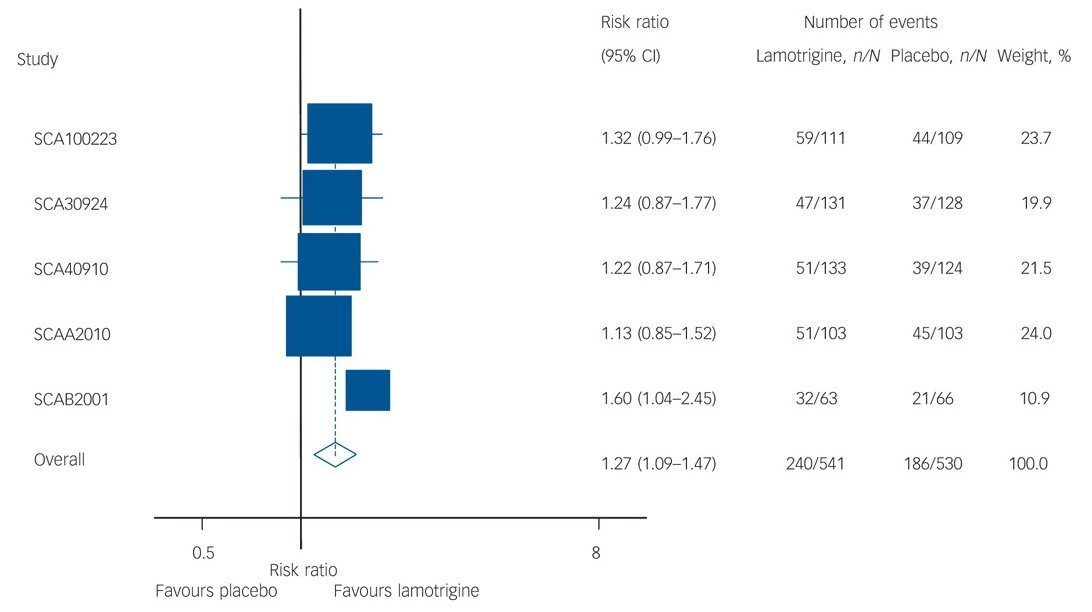 |
| Figure 1. Figure from Geddes et al - Meta-analysis of HRSD 50% response rates using individual patient data from GSK trials |
The response rates in this study are around 35% of patients in the placebo arm and 45% of those taking lamotrigine - so an increase of 10 percentage points due to lamotrigine. If we consider that, for the average patient, 50% improvement implies a minimum change of around 12 points on the HRSD the actual mean improvement of 1.0 points (and the standard deviation) seems a little small (in a back of the envelope calculation you could say that you would expect an average of 1.2 point improvement - thats 10% getting 12 points averaged over all the group). So a bit of a mixed bag I'd say.
Traditional meta-analysis versus individual patient data
A question that occurs to me is what extra information we gain from having the individual patient data? It is pretty rare to get hold of individual patient data when doing a meta-analysis, usually all we have is the overall results for each trial. Sometimes this doesn't make much difference, comparing the individual level meta-analysis by Fournier et al of antidepressants with Kirsch et al's meta-analysis did not reveal any major differences (and these studies looked at fairly different sets of antidepressants).
I had a quick go at performing a study level meta-analysis of the GSK lamotrigine data** and found that the response rate had a relative risk of 1.22 (1.06-1.41) (Figure 2 below) which is pretty similar to the individual level data 1.27 risk ratio.
 |
| Figure 2. Meta-analysis of HRSD 50% response rates from GSK per trial data |
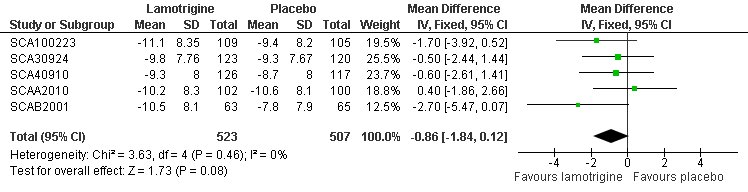 |
| Figure 3. Meta-analysis of mean difference in HRSD scores from GSK per trial data |
Antidepressant response and the severity of depression
Like many previous studies of antidepressants Geddes et al also find that there is an interaction between the size of the antidepressant effect of lamotrigine and how severely depressed the patients in the study were at baseline. They found a significant interaction on their ANCOVA analysis between baseline HRSD severity and final HRSD score with a regression coefficient of .30 (p=.04). They go on to comment that:
"Thus, the interaction by severity was because of a higher response rate in the moderately ill placebo-treated group, rather than, for example, a higher response rate in the severely ill lamotrigine-treated group."This statement is very redolent of Kirsch et al's claim:
"The relationship between initial severity and antidepressant efficacy is attributable to decreased responsiveness to placebo among very severely depressed patients, rather than to increased responsiveness to medication."Kirsch et al got a lot of stick for saying this, not least from yours truly, so I was interested in what a set of rather more mainstream figures in the psychiatric world (two Oxford academic psychiatrists and a psychiatrist from the GSK advisory board) were trying to say, and how this relates the Kirsch's work. Maybe I was being unfair to Kirsch?
Kirsch et al argued that the apparent increase in antidepressant efficacy with increasing baseline severity in trials was due to decreasing placebo response in more severe trials (see Figure 4 below). They further argued that this increasing efficacy was therefore only 'apparent' because the response to antidepressant was the same. I've discussed before how, on many levels, it is meaningless to claim that this effect is only 'apparent'.
 |
| Figure 4. Figure from Kirsch et al - Regression of baseline severity against standardised mean difference of HRSD score improvement for antidepressant and placebo groups using per trial data |
 |
| Figure 5. Regression of baseline severity against HRSD score improvement for antidepressant and placebo groups using per trial data from Kirsch et al |
 |
| Figure 6. Figure from Fournier et al - Regression of baseline severity against HRSD score improvement for antidepressant and placebo groups using individual patient data |
So what did Geddes et al find? Well, unlike Kirsch et al and Fournier et al they primarily looked at response rates rather than mean change in HRSD, obviously you can't have an individual patient's response rate (an individual either does, or does not respond) so they divided the subjects into two groups, those with a baseline severity below 24 points, and those above. They found that only those in the 'severe' severity (>24 point) group had a statistically significant response rate greater than placebo with 46% of those on lamotrigine responding compared to 30% on placebo. In the 'moderate' (<= 24 point) group response rates were 48% for lamotrigine and 45% for placebo. Geddes and others have argued that this increased placebo response at moderate severity is due to something like inflation of baseline severity at trial recruitment (that is doctors subconsciously inflate severity for those around the lower threshold for trial recruitment and they then regress to the 'real' lower score they would have had anyway when assessed blindly as part of the trial while this doesn't happen for the more severe patients).***
Now I've outlined some of my reservations about 50% reduction in HRSD score as a measure of 'response rate' and I don't think that these numbers necessarily show what Geddes et al think it does. Let's consider a simple model of how antidepressants might work, let's say they can be modelled simply by saying that an antidepressant reduces the baseline HRSD score by X HRSD points which is the simple sum of the placebo effect (P) and a 'true' antidepressant effect (A):
X = P + A
Based on this model, as discussed above, we can see how patients in the 'moderate' severity group could be more likely to respond even if X is the same for both severity groups. This is because a lower baseline severity means less HRSD points need to be lost to reach a 50% reduction. If we take this observation it is conceivable that the lower placebo response in the 'severe' group could be, at least partly, due to pure artefact. Given that those treated with lamotrigine in the 'severe' group had a larger response rate than those on placebo you might then go on to posit that maybe P is larger for the more severely depressed patients.
The way we ideally would want to answer this question would be to look at the mean HRSD scores as we did above for the data from Kirsch et al and Fournier et al. The response rate figures alone would still be completely consistent with a relationship like that shown in Figure 5 above and suggest that the claim that "the interaction by severity was because of a higher response rate in the moderately ill placebo-treated group" is false.
Unfortunately Geddes et al don't show the mean HRSD data by baseline severity nor do they report the correlations between mean HRSD score and baseline severity for the lamotrigine and placebo groups separately, either of which might help to answer this question. This is a bit odd as this is one of the main areas where the individual patient data would prove very useful and answer questions that the trial only data cannot. So we'll never know whether they do or don't show that placebo responses are constant, decreased, or increased with greater severity of depression. I've reproduced the data presenting each trial below (Figures 7 & 8) but these can't really answer this question, for that we need the within trial data.
 |
| Figure 7. Simple regression of mean baseline severity against 50% response rates from GSK per trial data split by lamotrigine (blue) and placebo (red) |
 |
| Figure 8. Simple regression of mean baseline severity against mean change in HRSD score from GSK per trial data split by lamotrigine (blue) and placebo (red) |
Summary
So, what should we conclude? Well a few things:
- Lamotrigine is not very effective for acute bipolar depression
- Individual patient data in these trials doesn't tell us much more than a classical meta-analysis
- The effect of lamotrigine, like other antidepressants in major depression, increases with greater baseline severity of depression, but never reaches the NICE 'clinical significance' criteria
- It is unclear exactly why antidepressant efficacy increases in this way but it is far from established that it is due to "higher response rate in the moderately ill placebo-treated [patients], rather than, for example, a higher response rate in the severely ill lamotrigine-treated [patients]"
So what next?
So what medication should be used for acute treatment of bipolar depression? Well I think the data from quetiapine is pretty promising and certainly a lot more convincing and impressive than for lamotrigine monotherapy. Perhaps lamotrigine will be synergistic when added to quetiapine and the first author, John Geddes, is heading up the CEQUEL trial looking at just this question.
* I think a better measure might be a fixed improvement in HRSD score, call it a 'clinically significant response', this would avoid the assumption that antidepressants somehow cause an X% reduction in HRSD score rather than say improving Y number of symptoms, and thus the problem I've mentioned above about how mildly depressed patients need less improvement to 'respond' than more severely depressed.
** I got the response rate data from the Geddes et al paper and the HRSD mean difference data from the GSK trials register (since it wasn't presented in the paper). I used mean change scores rather than final HRSD scores (although this shouldn't make much difference), I had to estimate standard deviations for trial SCA40910 and the means for trial SCA30924 were already adjusted for baseline severity. Data are for fixed effect models but random effects makes minimal difference to the results.
*** Interestingly this explanation would only be tenable if trials of greater severity showed the same within-trial effect as trials of lower severity, since this effect should take place at the recruitment threshold irrespective of what that threshold is. So therefore within a trial the less severe subjects around the recruitment threshold should show a greater placebo response whereas there would not necessarily be any relationship between average baseline severity and average response between trials. This means that my regression data from Figure 5 above doesn't necessarily argue against this model - what we need to know is whether this relationship holds within the trials, something that even the individual subject data from Figure 6 doesn't rule out because we'd ideally have data separately plotted for each trial since the recruitment thresholds for each trial may have differed.
Friday, 13 August 2010
Depression severity
Interesting post on neuroskeptic about the HAMD:
"The APA use the terminology "Very Severe", which doesn't even appear on other scales...But where did the APA get their system from? This is the most extraordinary thing. Here's the paper they based their approach on. It's an 1982 British study by Kearns et al...You'll recognize the APA's categories, kind of, but they're all shifted. Why? We can only guess. Here's my guess. The scores in that Kearns et al graph were the average HAMD scores of people who fell into each severity band. The APA must have decided that they could use these to create cutoffs for severity."
Tuesday, 30 March 2010
Serotonin hypothesis of depression
A post from The Twenty-First Floor on the serotonin hypothesis of depression:
The main aetiological explanation for depression in the public consciousness is undoubtedly the “serotonin hypothesis”. This probably manifests more popularly as the idea that depression is somehow the result of a “chemical imbalance” in the brain, and therefore that sufferers of depression (whose suffering is not in question) are somehow the passive victims of an organic condition, like victims of diabetes, for example, and that this can be righted with medication. It’s a neat explanation, which, I guess, is why it’s so appealing. However, the evidence, as it so often does, suggests that depression is nowhere near this simple.While I agree that the evidence for the serotonin hypothesis of depression (or even the rather wider monoamine hypothesis) is fairly weak, he links to this study finding mixed evidence for an association between suicide, impulsivity, and depression and serotonin metabolite levels. It is worth noting that a review by Mann et al (1989) is often taken as demonstrating that serotonin (or its metabolites) are reduced in the brainstem (source of serotonergic projections in the brain) in suicides, independent of underlying diagnosis. Although this actually only shows reduced serotonin in depressed suicides (if you look at the individual studies) that would actually make it stronger evidence for the hypothesis.
Friday, 26 March 2010
Treating depression in general medical patients
As a doctor with an interest in psychiatry currently working in general medicine the issue of depression in general medical patients is one that interests me. We commonly see overdoses secondary to depressive illness and depression in patients with terminal diagnoses but also in many other conditions, particularly chronic disease. While we have access to specialist psychiatric or palliative care services for the former conditions that still leaves a substantial number of depressed patients to care for, and that is something of a treatment dilemma.
Physical illness is strongly associated with depression and some 10-20% of general medical inpatients or outpatients have a depressive disorder. This is particularly marked for people with chronic disease where rates range from 11% of diabetics to 20% of people after a heart attack. Depression is a a risk factor for poor prognosis in physical disease, being associated with worse mortality, at least partly mediated via decreased adherence to treatment. Yet evidence shows that physically ill patients receive less antidepressant prescriptions than other depressed patients.
There are some specific challenges in recognising and treating depression in general medicine, early in an admission somatic symptoms of depression can difficult to distinguish from symptoms of physical illness and later on during treatment low mood can be considered 'understandable', with a natural resistance on the part of clinicians to medicalise normal emotional reactions. The inpatient environment is also unusual and stressful and it is unclear whether patients will maintain a low mood or improve when discharged home. Practically, the onset of antidepressants is generally believed to be delayed over two weeks which means that any effect may not be seen during an acute admission and psychological therapies such as CBT are just not available in general medicine.
In recent years the risks of self-harm and discontinuation syndromes with antidepressants have received significant coverage and since Irving Kirsch's 2008 paper much doubt has been raised about overall antidepressant efficacy in any other than the most severe patients. A recent Cochrane Review has addressed the question of antidepressant usage for depression in physically ill patients:
They looked at studies of depression quite broadly defined (major depressive disorder, adjustment disorder, dysthymia) and found 51 studies (mostly in SSRIs but also in tricyclics and a few less common antidepressants), with fluoxetine (Prozac) the drug most commonly studied (12 trials). The physical diseases studied included stroke (11 studies), HIV (7), Parkinson's disease (6), cancer (4), COPD (chronic bronchitis and emphysema; 3), diabetes (3) , heart attacks (2), and renal failure (2). At the two follow-up periods of most interest (6-8 wks and 9-18 wks) there were around 1,000-1,500 subjects included in the analysis.
 Overall they found that antidepressants were similarly effective at all follow-up durations (ranging from 4 to greater than 18 weeks) as seen in the summary figures on the right. We can see an odds ratio of around 2, that is antidepressants roughly double the chance of a 50% improvement in outcome score (most studies used the Hamilton Rating Scale for Depression) or showed a standardised mean difference of around 0.5*

Looking at other aspects they found that there were more people dropped out of the study from the antidepressant group than the placebo group (this was marginally significant) with an odds-ratio of 1.3 (95% confidence interval 1.0-1.8). Looking at side-effects, dry mouth and sexual dysfunction were both significantly more likely to be reported by those in the antidepressant group, the latter being primarily driven by those taking SSRIs. So overall antidepressants had side-effects sufficiently bad to lead more people to drop out of the study.
The study didn't find any striking differences between the efficacy of SSRIs and other antidepressants, nor differences between taking a narrow (major depressive disorder only) or broad definition of depression.
Looking at the I-squared statistic for trial hetrogeneity we can see that for dichotomous outcomes differences between trials were not very large but for the mean difference outcomes there was very large heterogeneity. However, this seems to be due to two studies with stonkingly big effect sizes (improvements greater than 10 points on the HRSD) and excluding these from analyses drops the I-squared right down without massively affecting the results.
Overall this is quite an interesting finding and it suggests that antidepressants can be really very effective for depression in physically ill patients. But there are some limitations to bear in mind:
 Looking at a funnel plot from the study we can see apparent publication bias (see right), the gap at the bottom left of the pyramid represents missing small trials (or rather, trials with a large standard error) with a large negative effect of antidepressants. This suggests that some negative trials (which we would have predicted would exist based on the effect size we are finding) are missing from the literature included in the review. This is an example of how small positive trials are much more likely to get published than small negative trials which disappear into the file drawer. Publication bias is a known problem in antidepressant trials. When Turner et al analysed data submitted to the FDA before approval** they found that 37/38 positive trials were published but only 14/36 negative trials were published, and 11 of these actually claimed a positive result!
Trial quality was disturbingly low, the authors used the 'Risk of Bias' table from the Cochrane Handbook to score as 'low risk', 'unclear risk', or 'high risk' of bias on six items:
 Only three studies scored as 'low risk' of bias on four or more items*** and only something like 13 on three or more items. The authors find that by looking only at these 13 odd studies the effect size is not grossly different to looking at all the studies. If we just look at the three best quality studies (see right, data from 9-18wks) there is a large effect that is not statistically significant for the mean difference in HRSD scores (but it is significant looking at SMD) that suggests that it isn't purely low quality trials driving the beneficial effect of antidepressants seen in this study.
 Not looking at the effect of baseline severity in the wake of Kirsch et al and its widespread impact is curious. Kirsch et al, looking at the same FDA data as Turner et al, found that the NICE threshold for 'clinical significance' (an improvement of 3 points on the HRSD or 0.5 SMD) was reached around a baseline severity (as measured by the HRSD) of 26 points, which is classified as 'very severe' by NICE and the American Psychiatric Association (see right). Similar results were found by Fournier et al looking at individual subject level data.
 I made a back of the envelope attempt to plot the meta-analysis data against baseline severity**** and we find that the NICE threshold is actually reached at quite low baseline severity (18.5-21.5) which falls in the upper range of moderate through to severe severity.
 In summary, studies of antidepressant use in physical illness indicate a large effect size that is 'clinically significant' in the 'severe' depression range, and there is a disparity between the large effects sizes in this review and in other studies of depression. Although I have some criticisms of Kirsch et al it seems most likely that this disparity is due to publication bias in the Cochrane meta-analysis. There are some interesting issues regarding the way that studies in general depression usually have a more severe major depression population and any extrapolation to less severe patients is on the basis of few studies whereas the Cochrane review includes a number of less severe conditions and it is possible that this makes it therefore more sensitive to beneficial effects at the lesser degrees of severity. It is also possible that physically ill patients may be more responsive to antidepressants but I'm unconvinced.
This study looked at largely outpatient populations with chronic illness and it isn't clear whether the results are directly applicable to inpatient populations but it certainly supports the use of antidepressants in inpatient depression and suggests that at the very least they are likely to be as effective in this population as in the general population of depressed patients.
Finally it is worth noting that NICE has a guideline on treating depression in chronic physical illness which makes recommendations which are broadly similar to those they make for depression in general:
* Standardised mean difference is the difference between the mean outcome scores for the antidepressant and placebo groups divided by the standard deviation, this corresponds to something like a difference of 4 points on the HRSD. Since many studies don't report dichotomous 'improvement' measures, or use different definitions, and these have to be 'imputed' using the mean difference data (making assumptions about how the data is distributed), I prefer mean difference data, ideally using the raw HRSD figures rather than the standardised mean difference (since this can create odd distortions in the data, e.g. in Kirsch et al's study). Almost all studies use the original 17-item HRSD but the few studies that instead use, say, the Montgomery-Åsberg Depression Rating Scale means that the authors have used the SMD so that this data can be combined (the SMD is supposed to allow you to combine data from different scales that are intended to measure the same thing).
** This data should be free from publication bias because the FDA legally mandates the pharmaceutical companies to supply all studies performed on the drug.
*** Cochrane actually discourage adding these up to produce a scale but I can't think of a better way to see which studies are more or less biased.
**** Only including those studies with HRSD data, and those trials where I could access the article and extract it. Since I didn't try too hard to check everything it is quite possible some scoring from scales other than the 17-item HRSD crept in there.
UPDATE
 In response to neuroskeptic in the comments, here's the baseline severity data split by antidepressant and placebo groups (as seen in Kirsch et al's analysis), the regression is weighted by sample size, the baseline severity is mean HRSD score, the improvement is mean baseline severity minus mean HRSD score at 6-8 weeks. We can see that increasing baseline severity leads to increasing response to antidepressant with placebo response fairly flat. This was pretty much what we found when we looked at HRSD outcome data from the Kirsch et al study.
Physical illness is strongly associated with depression and some 10-20% of general medical inpatients or outpatients have a depressive disorder. This is particularly marked for people with chronic disease where rates range from 11% of diabetics to 20% of people after a heart attack. Depression is a a risk factor for poor prognosis in physical disease, being associated with worse mortality, at least partly mediated via decreased adherence to treatment. Yet evidence shows that physically ill patients receive less antidepressant prescriptions than other depressed patients.
There are some specific challenges in recognising and treating depression in general medicine, early in an admission somatic symptoms of depression can difficult to distinguish from symptoms of physical illness and later on during treatment low mood can be considered 'understandable', with a natural resistance on the part of clinicians to medicalise normal emotional reactions. The inpatient environment is also unusual and stressful and it is unclear whether patients will maintain a low mood or improve when discharged home. Practically, the onset of antidepressants is generally believed to be delayed over two weeks which means that any effect may not be seen during an acute admission and psychological therapies such as CBT are just not available in general medicine.
In recent years the risks of self-harm and discontinuation syndromes with antidepressants have received significant coverage and since Irving Kirsch's 2008 paper much doubt has been raised about overall antidepressant efficacy in any other than the most severe patients. A recent Cochrane Review has addressed the question of antidepressant usage for depression in physically ill patients:
Rayner et al 'Antidepressants for depression in physically ill patients' Cochrane Database of Systematic Reviews 2010, Issue 3.
They looked at studies of depression quite broadly defined (major depressive disorder, adjustment disorder, dysthymia) and found 51 studies (mostly in SSRIs but also in tricyclics and a few less common antidepressants), with fluoxetine (Prozac) the drug most commonly studied (12 trials). The physical diseases studied included stroke (11 studies), HIV (7), Parkinson's disease (6), cancer (4), COPD (chronic bronchitis and emphysema; 3), diabetes (3) , heart attacks (2), and renal failure (2). At the two follow-up periods of most interest (6-8 wks and 9-18 wks) there were around 1,000-1,500 subjects included in the analysis.


Looking at other aspects they found that there were more people dropped out of the study from the antidepressant group than the placebo group (this was marginally significant) with an odds-ratio of 1.3 (95% confidence interval 1.0-1.8). Looking at side-effects, dry mouth and sexual dysfunction were both significantly more likely to be reported by those in the antidepressant group, the latter being primarily driven by those taking SSRIs. So overall antidepressants had side-effects sufficiently bad to lead more people to drop out of the study.
The study didn't find any striking differences between the efficacy of SSRIs and other antidepressants, nor differences between taking a narrow (major depressive disorder only) or broad definition of depression.
Looking at the I-squared statistic for trial hetrogeneity we can see that for dichotomous outcomes differences between trials were not very large but for the mean difference outcomes there was very large heterogeneity. However, this seems to be due to two studies with stonkingly big effect sizes (improvements greater than 10 points on the HRSD) and excluding these from analyses drops the I-squared right down without massively affecting the results.
Overall this is quite an interesting finding and it suggests that antidepressants can be really very effective for depression in physically ill patients. But there are some limitations to bear in mind:
- Most studies were pretty small, almost all with less than 100 subjects and we know that small studies are more likely to overestimate the size of the beneficial effect
- Trial quality was actually pretty low, and low quality trials are known to overestimate effect sizes (more on this below)
- Publication bias was apparent in the studies (more below)
- The effect of baseline severity has become a hot topic since Kirsch et al and this study didn't look at this (more below)
- They looked only at the 10 most common side-effects but not overall adverse event rates, or specifically serious adverse events, and this prevents detection of less common but serious complications (stuff like death or suicide)
- No subgroup analyses were performed to see if antidepressants were more effective in specific physical illnesses (say in stroke rather than HIV)
- They did not look at studies with co-morbid psychiatric illness, this is important because mixed disorders, particularly with aspects of both depression and anxiety, are very common

Trial quality was disturbingly low, the authors used the 'Risk of Bias' table from the Cochrane Handbook to score as 'low risk', 'unclear risk', or 'high risk' of bias on six items:
- Sequence generation
- Allocation concealment
- Blinding
- Incomplete outcome data
- Selective outcome reporting
- Other issues


This study looked at largely outpatient populations with chronic illness and it isn't clear whether the results are directly applicable to inpatient populations but it certainly supports the use of antidepressants in inpatient depression and suggests that at the very least they are likely to be as effective in this population as in the general population of depressed patients.
Finally it is worth noting that NICE has a guideline on treating depression in chronic physical illness which makes recommendations which are broadly similar to those they make for depression in general:
- For low persistent subthreshold depressive symptoms or mild to moderate depression:
- Low intensity psychosocial intervention (e.g. computerised CBT etc.)
- If symptoms persist, previous severe depression, or symptoms compromising care consider either:
- SSRI (citalopram or sertraline first line)
- High intensity psychosocial intervention (e.g. individual CBT etc.)
- Severe depression
- Antidepressant and individual CBT
- Be aware of drug interactions
* Standardised mean difference is the difference between the mean outcome scores for the antidepressant and placebo groups divided by the standard deviation, this corresponds to something like a difference of 4 points on the HRSD. Since many studies don't report dichotomous 'improvement' measures, or use different definitions, and these have to be 'imputed' using the mean difference data (making assumptions about how the data is distributed), I prefer mean difference data, ideally using the raw HRSD figures rather than the standardised mean difference (since this can create odd distortions in the data, e.g. in Kirsch et al's study). Almost all studies use the original 17-item HRSD but the few studies that instead use, say, the Montgomery-Åsberg Depression Rating Scale means that the authors have used the SMD so that this data can be combined (the SMD is supposed to allow you to combine data from different scales that are intended to measure the same thing).
** This data should be free from publication bias because the FDA legally mandates the pharmaceutical companies to supply all studies performed on the drug.
*** Cochrane actually discourage adding these up to produce a scale but I can't think of a better way to see which studies are more or less biased.
**** Only including those studies with HRSD data, and those trials where I could access the article and extract it. Since I didn't try too hard to check everything it is quite possible some scoring from scales other than the 17-item HRSD crept in there.
UPDATE

Sunday, 31 January 2010
The drugs do work?
An interesting article in the NY Times by psychiatrist Richard Friedman:
My analysis could only correct for baseline severity on a per trial basis whereas the above study was a patient level meta-analysis which is a better approach when available. So while the above study did include only two antidepressants (one of which was the older tricyclic class, although these are thought to be similarly effective to the newer SSRIs, just with more side-effects) it is consistent with the study by Kirsch et al, even given the criticisms of it I've previously raised.
So I don't think Friedman's criticism holds up, I think a more sensible attack is that the NICE threshold is entirely arbitrary, an argument I made at the time of Kirsch's paper.
Last week, The Journal of the American Medical Association published a study questioning the effectiveness of antidepressant drugs. The drugs are useful in cases of severe depression, it said. But for most patients, those with mild to moderate cases, the most commonly used antidepressants are generally no better than a placebo.Neuroskeptic has blogged about this study before (Fournier et al 2010 JAMA 303(1)), but it is worth noting that, despite my criticisms of Irving Kirsch's meta-analysis of the FDA data on antidepressant efficacy, even when I reanalysed the data I found that the NICE threshold for 'clinical significance' was met at around a baseline severity of 26 points on the Hamilton scale. In this study by Fournier et al the threshold was met around a baseline severity of 25 points.
...the authors of the new analysis gave themselves an additional handicap: they decided to exclude a whole class of studies, those that tried to correct for the so-called placebo response.
...
Another drawback of the study is that its conclusions are based on studies that included only two antidepressants — when there are 25 or so on the market. By contrast, when the Food and Drug Administration wanted to investigate the safety of antidepressants, it analyzed data from some 300 clinical trials, with nearly 80,000 patients, involving about a dozen antidepressants.
...
Every once in a while, a landmark study comes along and overturns everyone’s cherished ideas about a particular treatment. But the current study is not one of them. So it would be a shame if it discouraged depressed patients from taking antidepressants.
My analysis could only correct for baseline severity on a per trial basis whereas the above study was a patient level meta-analysis which is a better approach when available. So while the above study did include only two antidepressants (one of which was the older tricyclic class, although these are thought to be similarly effective to the newer SSRIs, just with more side-effects) it is consistent with the study by Kirsch et al, even given the criticisms of it I've previously raised.
So I don't think Friedman's criticism holds up, I think a more sensible attack is that the NICE threshold is entirely arbitrary, an argument I made at the time of Kirsch's paper.
Tuesday, 1 September 2009
Tedious psychological turf wars
Richard Bentall has a new book out so it was only a matter of time before he made his way into the British press. I don't have time for an indepth critique but here's a few selected highlights:
The whole piece is a depressing blow in a pointless academic turf war where psychologists seek to undermine 'biological' psychiatric research (which, is to some extent justified) only to posit even weaker little barely-theories to replace it:
The problem wth Bentall (and I've read Madness Explained) is that he makes valid but somewhat overstated arguments against things like psychiatric labels or the efficacy of psychoactive drugs but then thinks that he has somehow completely demolished existing medical understanding of mental illness and its treatment (rather than having slightly deflated its claims) and then goes on to make 'psychological' theories that are often much worse supported that the 'biological' theories he has just tried to undermine and also to present them as radically opposed to existing understanding rather than being complementary (which is what they are).
This is really just a slightly more sophisticated vesion of Oliver James - if mental illness doesn't have a genetic component then drugs don't work, if mental illness is associated with childhood abuse then we need psychological therapies. That mental illness is probably both partly genetic and partly associated with envronmental factors including childhood abuse (a) tells us nothing about whether drugs or therapy work, and (b) that the evidence tells us that both drugs and therapy work (depending on the diagnosis) is just too complex and nuanced for this pathetic dick-swinging Sunday supplement debate.
"Many studies have also reported an association between trauma in early life and psychosis. These effects are large: one recent study estimated that individuals who had been sexually abused in childhood were 12 times more likely than others to suffer from serious mental illness, and another calculated that the population-attributable risk of a diagnosis of schizophrenia associated with an inner-city childhood was 15% (that is, there would be 15% fewer cases if we all grew up in the countryside). The risk associated with having a parent with the diagnosis is 7% (ie, there would be 7% fewer cases if patients stopped having children)."(my emphasis)Note that what this segment subtly doesn't point out is that the evidence suggests that schizophrenia in particular isn't actually associated with childhood abuse (unlike, say, depression).
The whole piece is a depressing blow in a pointless academic turf war where psychologists seek to undermine 'biological' psychiatric research (which, is to some extent justified) only to posit even weaker little barely-theories to replace it:
These effects are understandable in the light of psychological research. For example, early trauma seems to disrupt the process by which we distinguish between our own thoughts and our perceptions, leading to a specific risk of hallucinations. Disruption of early relationships with caregivers, coupled with victimisation, create a tendency to mistrust others and to anticipate threats, leading to paranoid delusions.(my emphasis)I mean, seriously, what is the highlighted sentence even supposed to be telling us? That there is an association between trauma and hallucination? But he's just told us that, what does 'psychological research' tell us on top of that? What are the useful therapeutic insights that this research igives us?
To date, about 30 trials of cognitive therapy for psychosis have been completed; by comparison, in the period 2001-3, nearly 400 drug trials were published in the five leading American psychiatric journals. There is therefore an urgent need to develop a less drug-based, more person-centred approach to understanding and treating mental illness, which builds on the recent scientific findings and which takes the experiences of patients seriously.CBT is similarly effective to antidepressants (but of little use in psychosis compared to anti-psychotics) but if psychologists think the recent success of psychological therapies supports their approach then they are going to have to look very hard at why their therapies are little better (and often worse) than the 'biological' therapies they seek to undermine.
The problem wth Bentall (and I've read Madness Explained) is that he makes valid but somewhat overstated arguments against things like psychiatric labels or the efficacy of psychoactive drugs but then thinks that he has somehow completely demolished existing medical understanding of mental illness and its treatment (rather than having slightly deflated its claims) and then goes on to make 'psychological' theories that are often much worse supported that the 'biological' theories he has just tried to undermine and also to present them as radically opposed to existing understanding rather than being complementary (which is what they are).
This is really just a slightly more sophisticated vesion of Oliver James - if mental illness doesn't have a genetic component then drugs don't work, if mental illness is associated with childhood abuse then we need psychological therapies. That mental illness is probably both partly genetic and partly associated with envronmental factors including childhood abuse (a) tells us nothing about whether drugs or therapy work, and (b) that the evidence tells us that both drugs and therapy work (depending on the diagnosis) is just too complex and nuanced for this pathetic dick-swinging Sunday supplement debate.
Saturday, 7 March 2009
Are the new antidepressants any better?
You may recall that the Kirsch et al study showed a trend (that was not statistically significant) for venlafaxine to be superior to other antidepressants. But there are a number of newer antidepressants, how do they compare to the vanilla SSRIs?
A new meta-analysis in the Lancet tried to find out:
A new meta-analysis in the Lancet tried to find out:
"Mirtazapine, escitalopram, venlafaxine, and sertraline were significantly more efficacious than duloxetine (odds ratios [OR] 1·39, 1·33, 1·30 and 1·27, respectively), fluoxetine (1·37, 1·32, 1·28, and 1·25, respectively), fluvoxamine (1·41, 1·35, 1·30, and 1·27, respectively), paroxetine (1·35, 1·30, 1·27, and 1·22, respectively), and reboxetine (2·03, 1·95, 1·89, and 1·85, respectively). Reboxetine was significantly less efficacious than all the other antidepressants tested. Escitalopram and sertraline showed the best profile of acceptability, leading to significantly fewer discontinuations than did duloxetine, fluvoxamine, paroxetine, reboxetine, and venlafaxine."I haven't read it yet, so I can't speak for its veracity.
Friday, 6 March 2009
Someone else on anti-depressants and placebo
Nice post on Neuroskeptic looking at a recent meta-analysis of anti-depressants:
After fifty years of research, and untold millions of research dollars, there are hundreds of published clinical trials of antidepressants. It's when you try to make sense of the results of this great mass of trials that the problems become apparent. The latest attempt to do that is a paper from a German-American collaboration, Rief et. al.'s Meta-analysis of the placebo response in antidepressant trials. The authors set out toRead it all.Determine overall effect sizes of placebo and drug effects in antidepressant trialsIn other words, they wanted to find out how much people improve when given antidepressants, and how much of that improvement is due to the placebo effect.
Monday, 10 November 2008
Mental health and incapacity benefit
Ben Goldacre has a show on Radio 4 about incapacity benefit, which has prompted me to write this loser length post (more of an essay really). Millions of adults receive incapacity benefits in the UK and over the last ten years mental ill health has grown to become one of the major reasons. This is now costing some billions of pounds in benefits yet we know that unemployment is generally harmful to mental health while return to employment can help improve mental health. While the Government has been noticeably successful in reducing levels of those on unemployment benefit it has had little effect on levels of incapacity benefit.
I'd like to discuss the reasons for the poor employment rate of those with mental illness, why mental ill-health now accounts for such a large proportion of incapacity benefit, what can be done to help those with mental illness back into work and what impact Labour's proposed reform of the incapacity benefit system is likely to have.

Introduction
There are around 2.7 million people receiving incapacity benefits in the UK (more than a trebling since 1979). These consist of ‘Incapacity Benefit’ proper (1.4 million), the main contributory benefit for those incapable of work because of illness or disability and with sufficient National Insurance contributions, and those receiving income support (1 million) or the legacy benefit ‘Severe Disablement Allowance’ (.3 million). Around half of IB claimants are over 50 (1.3 million) with equal proportions of men and women by age, except that women retire five years earlier at 60, so there is a greater overall number of men (although the retirement age for women will rise to 65 in the future), and they are more likely to be getting the contributory benefit. There is a view that IB claimant numbers will fall away through time as a cohort of older claimants reaches state pension age because a large part of this cohort is made up of older men who were made redundant during the wave of industrial job losses in the '80s. But projections suggest that there will be no fall over the next 10 years given existing stocks and flows.
The proportion of incapacity benefit claimants with mental ill-health as their main disability has increased steadily over the last ten years from a quarter of claimants in 1996 to over 40% of claimants in 2006, with a further 10% of claimants with mental illness as a secondary factor. This has also been accompanied by an increasing proportion of the working age population claiming incapacity benefits, rising from 2% in the 1970s to 7% today (figure top right - proportion of working age population in receipt of incapacity benefits from ref [2]), a continuation of a trend since the 1950s in sickness pay generally [8]. Although inflows onto incapacity benefits have fallen 40% over the last decade this has been offset by a 35% reduction in outflows, resulting in only a small net decline in claimants.
The Government has been noticeably successful in reducing levels of those on unemployment benefit since 1997, through a combination of welfare reform and a favourable economic climate. Incapacity claims, however, have continued to rise; now representing the largest group of working age benefit claimants without employment. There are currently more mentally ill people drawing incapacity benefit than there are unemployed people on Jobseeker’s Allowance, resulting in an overall cost to the Exchequer of £10 billion.
In the non-disabled population some 80% of people are employed and only 4% dependent on benefits. For people with a disability the employment rate is 50%, but those with mental illness have the lowest employment rate of any disabled group (with the exception of learning disabilities) at 20%. Therefore two-thirds of people with mental ill-health are dependent on state benefits, compared with one-third of disabled people in general. It has been estimated that the reduced employment rate of those with mental illness costs another £10 billion in lost productivity [6].
Apart from the direct financial costs of reduced employment there is evidence that unemployment is generally harmful to health, particularly mental health. Conversely, return to employment is associated with improved general and mental health. Paid employment offers financial, psychological and social benefits to people with mental health problems that can facilitate psychological recovery and symptom reduction.
Mental illness and employment
One way to think about incapacity benefit claimants with mental ill-health is as a subset of all people with mental illness. As mentioned above, people with mental illness have very low rates of employment, and, according to the Psychiatric Morbidity Survey, some 16% of adults of working age have a mental illness, of whom up to a half are seriously ill. Unemployment rates for those with serious mental health problems range from 60% to over 95%. Thus, it is not surprising that people with mental health problems make up a significant proportion of those claiming incapacity benefit. This high unemployment is at least partly due to social factors such as stigma in addition to the direct consequences of mental health problems on the ability to work.
There are potentially two approaches to the problem of low employment for those with mental illness. The first is to tackle mental illness directly, and the other is to improve the employment prospects of those with mental illness. The former is beyond the scope of this discussion but it is worth noting that the majority of NHS resources for mental illness go to the 1% of the population with psychotic illness. Only around half of depressed patients receive any treatment and less than 10% have seen a psychiatrist.
Given the evidence for the efficacy of pharmacological and cognitive behavioural therapy (CBT) in conditions such as depression and anxiety it has been argued that expanding the provision of therapy, particularly CBT where waiting times are currently very long, will result in substantial cost savings due to increased productivity as well as reduced suffering and morbidity [6]. Certainly GPs should consider initiating treatment in anyone that they are signing off work on mental health grounds. In studies of those with mental illness who manage to return to work from incapacity benefit almost all report that improvement in their mental health was a major factor, whether this be due to medication, therapy, or resolution of underlying stressors, and in those claiming incapacity benefit those with mental ill-health are the most likely to regard their condition as improving [9].
It has long been recognised that people with severe mental illness require help to re-enter the workforce. Pre-vocational training provides a period of preparation before entering into competitive employment. Work projects have long been utilised as a route into the labour market for people with mental health problems. Sheltered work creates part-time jobs, with low ‘therapeutic’ pay that doesn’t affect entitlement to benefits. This approach has a long history but is associated with relatively poor quality products and conditions and infrequent transition into paid employment.
Alternative models have attempted to formulate something of a halfway house between sheltered employment and the open market but supported employment programmes seek to facilitate the employment of people directly in the open workforce with market pay and conditions. This approach places people into jobs without extended preparation but provides support during employment such as for reasonable adjustments in the workplace. Studies from the US have shown supported employment to be more effective than pre-vocational training in helping people with severe mental illness to obtain employment in the open market at similar cost [5] and this result has been replicated in a European RCT [4]. This supports the use of supported employment programmes in facilitating the employment of those with severe mental illness and suggests consideration of this model for those with less severe forms of mental ill-health.
Incapacity benefit and mental ill-health
An alternative way to consider people on incapacity benefits with mental ill-health is as a subset of those claiming incapacity benefit overall.
Many reasons have been posited for the growth in incapacity benefit claimants over time. It has long been proposed that the impoverishment of old industrial areas is a causal factor. There are also suspicions that governments have used the higher payments of incapacity benefit as an incentive to reduce the headline numbers of those claiming unemployment benefit through transition to incapacity.
Along with this post-industrialisation the labour market has changed with an increasing predominance of low paid jobs with few prospects, many of which are part-time or temporary, resulting in poor employment stability and a tendency to enter and exit the labour market more frequently. For those claimants on benefits for a long time there is also now a mismatch between their perceptions of the workplace and the reality and they may need considerable help to prepare them to re-enter the workforce.
Evidence suggests that the state of the local labour market has a strong effect on the likelihood of disabled people working and it has been estimated that up to 40% of incapacity benefit claimants could be ‘hidden unemployed’ based on underlying rates of incapacitating ill health and the incapacity benefit claimant rates in areas of full employment. This would support the use of macroeconomic tools to improve the conditions in the labour market to encourage those with mental illness to re-enter employment. However, the creation of nearly two million new jobs between 1997 and 2005 was not associated with a fall in incapacity benefit claimants and other sources of labour filled the gap. Therefore, even if incapacity benefit claimant levels represent underlying economic trends, it may well require more than simply reversing these trends at a national level to tackle incapacity benefit levels.
The increasing proportion of incapacity benefit claimants with mental illness is due both to people with mental health problems leaving incapacity benefits more slowly than those with other disabilities as well as a relatively high proportion of new claimants with mental illness. The increasing contribution of mental illness to incapacity benefit claims is primarily in ‘depressive and neurotic’ conditions rather than psychoses which have remained fairly stable in incidence (and thus fallen as a proportion of claims) [8]. Consistent with the view that increasing incapacity benefit claims are the result of wider socioeconomic factors, rather than mental ill-health per se, the increase in claimants with mental ill-health has occurred despite no apparent increase in the prevalence of mental disorders (except for alcohol dependence) in the wider community. Similarly, the wide variations in numbers of incapacity benefit claims, where the North of England, Scotland and Wales have rates double that of the South of England is not reflected in the underlying prevalence of mental illness in those populations.
Ninety percent of people who start claiming incapacity benefit expect to return to work, and around 60% of people starting on incapacity benefit stop claiming within a year. However, once on incapacity benefit those that expect never to leave it trebles, and those that stay on benefits for more than two years are more likely to retire or die than get another job. This compares to less than 5 per cent of those on unemployment benefits who have been claiming for over five years. More adults with long-term mental health problems report that they wish to return to work than people with other disabilities, yet evidence from welfare to work programmes such as the New Deal for Disabled People and Pathways to Work suggests that people with mental health conditions have not been helped to the same extent as those with physical illness.
The bulk of incapacity benefit claimants are aged over 50yrs but the prevalence of mental health problems in claimants is highest among younger claimants. Of recent applicants for incapacity benefit those with mental ill-health are less likely to be currently working or to have a job to return to than other applicants. They are also more likely to say that they have low confidence about working, that they will need help, rehabilitation or other assistance before they could consider working, that they are unlikely to get a job due to their sickness record, and that they would be financially worse off if they got a job. Recent claimants with mental health problems were twice as likely as those with only physical conditions to report that they had problems with numeracy or literacy [9].
Even among those claming incapacity benefit for conditions other than mental health problems reported depression, stress, and anxiety are very high. In fact many of those claiming incapacity benefit with mental illness as their main condition also have a physical illness (although this could partly be due to the greater emphasis on physical conditions under the current capability assessment questionnaire) and those with comorbid physical and mental illness are more likely than those with physical or mental illness alone to fail to return to work. Studies have demonstrated a link between poverty and mental illness, with poverty causing mental ill-health as well as being a consequence, including through reduced standards of living causing depression and anxiety. Many people entering incapacity benefit do not come via employment but rather other benefits and it is conceivable that they have developed mental health problems at least in part due to the stresses of unemployment and poverty. The prevalence of mental ill-health is also especially high for people entering incapacity benefit who have been recently care-giving or looking after the home or children.
There is a strong interaction between physical and mental illness (such as the transition from acute to chronic back pain) and it is possible that poor management of physical illness could contribute to the emergence of depression and anxiety through loss of social roles, isolation, and poverty. Government trials of early access to psychological therapy have produced a 5% reduction in patients claiming sick pay through returning people to work [2].
There is evidence for an association between poor mental health and factors in the workplace such as long hours and workload and interventions use training and organisational approaches to increase support or participation in decision making can improve psychological health and levels of sickness absence [7]. Few people regard works stress as the sole trigger of their mental ill health but it is commonly cited as an exacerbating factor. Some people moving onto incapacity benefit with mental ill-health from work report having requested amelioration of work stress but none of these explicitly related these requests to mental health problems [9]. This highlights the reluctance of people to communicate their mental health problems to employers. When an employee develops a mental health problem they may initially exhibit reduced job performance which can cause loss of job satisfaction causing further decline in mental health.
Around two-thirds of those entering incapacity benefit with mental ill-health from employment regard the loss of their job as being due to their mental illness, while 20% say it was due to other unrelated factors (such as termination of contract) [9]. The period of sick leave before transition to incapacity benefit is likely to be a critical period and most people have not discussed their mental health problems with their employer at this point. It is therefore worth considering early intervention at this stage to try and prevent transition from sick leave onto incapacity benefit and to facilitate communication between health services, employee and employer.
A high proportion of incapacity benefit claimants with mental health problems report that their problems fluctuate over time, particularly in comparison to those with physical illness, and they are more likely to be younger and have characteristics that disadvantage them in gaining employment such as no recent employment, a poor work history, and minimal qualifications. Employers particularly discriminate against a history of long-term sick leave and are half as likely to say they would employ someone with a mental illness compared to someone with a physical illness.
Around a third of entrants onto incapacity benefit are not claiming for the first time, and a third have received unemployment benefit in the last two years. People with mental health problems are less likely to have moved onto incapacity benefit via work than other claimants, and this suggests that there is a considerable degree of movement into and out of incapacity benefit and employment and that this could be worse for those with mental illness due to their fluctuating course and adverse work history.
Fluctuating illness makes it difficult to return to work and difficult to reclaim benefits when leaving work again. The benefits system is not designed to cope with this other than in the short term and job retention may be facilitated by giving disabled people in employment a right to temporary leave to allow them time for rehabilitation support with a guaranteed return to work.
Problems with the incapacity benefits system include a failure to prevent people from moving onto incapacity benefits, benefits trapping people into dependency with financial disincentives to finding work or training, the likelihood of leaving benefits rapidly decreasing over time as people become disconnected from the workplace, financial incentives to stay on benefits for longer (incapacity benefit rates increase over time), and a lack of support for moving into employment.
Government reforms
The Government aims to reduce incapacity benefits claimants by one million from 2.7 million to 1.7 million over the 10 years from 2006 to 2015. It is using a combination of anti-discrimination legislation and reform of the benefit and employment systems to try and tackle incapacity benefit levels [1].
A new Employment and Support Allowance (ESA) replaced incapacity benefits for new claimants in October 2008 (being rolled out to existing claimants 2009-2013), with capability reports focusing on what people can do, rather than what they cannot and the ‘Pathways to Work’ scheme being rolled out across the country with compulsory work focused interviews, ‘Condition Management Programmes’, and financial bonuses for return to work. ESA rates will be comparable to jobseeker's allowance, rather than current IB levels, with the minority exempted from seeking work qualifying for an increased rate. Evidence from trials of Pathways suggests an eight percentage point increase in the incapacity benefit off-flow rates (figure bottom right - incapacity benefit 6-month off-flow rates from ref [3]) but unfortunately this benefit is not translated through to those with mental health problems. There is an additional concern that the destination of over half of those leaving IB is unknown, and the second largest group (25%) is those transferring to another benefit, only 4% return to work. There are substantial and rapid transfers between IB and job seeker's allowance, and, of those entering work from IB, some 14% return to IB within the year.
The reasons for the failure of Pathways to help those with mental health problems return to work is unclear. It is certainly the case that these claimants have an increase in those factors with have an adverse effect on gaining employment such as a poor work history. The recurrent pattern of mental illness may also make it difficult to stay in the workplace. Although GPs have not traditionally regarded as their role to be involved in detailed discussions about employment with their patients they could be encouraged to emphasis the importance of work for well being and self esteem.
In Pathways areas a formal 'In-Work Support' programme is available but this only lasts for six months. This has not been widely taken up but could be extended to form the basis for a supported employment model similar to that seen with severe mental illness to facilitate returning to and staying in work.
 The Government’s published plans [1] do not currently contain any provisions to help people to remain in work during their initial period of ill-health. Carol Black has made a number of recommendations that go beyond the governments plans for helping those on incapacity benefit back to work [2] and, in particular, she proposes an early intervention service called ‘Fit for Work’ where a GP can refer patients to a multidisciplinary team with a case manager liaising with GP and employer. This might provide exercise and physical activity along with psychological therapies, physiotherapy and occupational therapy, social services help, and occupational health interventions such as workplace assessment and modification. Currently the Government has undertaken to trial this proposal.
GPs generally do not have easy access to mental health specialists from either occupational health or general psychiatry and the raft of new proposals appear to place considerable further burdens on GP time and expertise. Perhaps it is time to go further than ‘Fit for Work’ and consider the establishment of a specialised state occupational health service where capability assessors are controlled and trained by the government rather than contracted out (the current capability assessment contract is with Atos Origin until 2012). This could help address the widespread concern that under the existing system of capability assessment mental health problems are inadequately assessed, underemphasised and minimally explored and thus provide minimal benefit to advisers seeking to place claimants into work.
It seems likely that mental health problems will continue to represent a major proportion of those claiming incapacity benefits, although the reasons for this are far from clear (and likely multi-factorial), but, despite some limited success in reducing IB levels of those with physical illness in trial areas, it is not obvious that current proposals are likely to have much of an impact on helping people with mental health problems into work. The current disconnection between psychiatric, social, and employment services needs to be tackled before a comprehensive and succesful attempt can be made to reverse the long standing disengagement of people with mental health problems from the workforce. As things currently stand it looks like recent welfare reforms will result in a large increase in unemployment levels amongst the mentally ill, with a consequent cut in living standards.
[1] No one written off: reforming welfare to reward responsibility. Department for Work and Pensions, TSO, 2008.
[2] Black, C., Working for a healthier tomorrow. Health, Work and Well-being Programme, TSO, 2008.
[3] Blyth, B., Incapacity Benefit reforms - Pathways to Work Pilots performance and analysis. Working Paper No 26, Department for Work and Pensions, HMSO, 2006.
[4] Burns, T., Catty, J., Becker, T., Drake, R.E., Fioritti, A., Knapp, M., Lauber, C., Rossler, W., Tomov, T., van Busschbach, J., White, S. and Wiersma, D., The effectiveness of supported employment for people with severe mental illness: a randomised controlled trial, Lancet, 370 (2007) 1146-52.
[5] Crowther, R.E., Marshall, M., Bond, G.R. and Huxley, P., Helping people with severe mental illness to obtain work: systematic review, Bmj, 322 (2001) 204-8.
[6] Layard, R., Mental Health: Britain's Biggest Social Problem? No.10 Strategy Unit Seminar on Mental Health, 2005.
[7] Michie, S. and Williams, S., Reducing work related psychological ill health and sickness absence: a systematic literature review, Occup Environ Med, 60 (2003) 3-9.
[8] Moncrieff, J. and Pomerleau, J., Trends in sickness benefits in Great Britain and the contribution of mental disorders, J Public Health Med, 22 (2000) 59-67.
[9] Sainsbury, R., Irvine, A., Aston, J., Wilson, S., Williams, C. and Sinclair, A., Mental health and employment. Research Report No 513, Department for Work and Pensions, HMSO, 2008.
Subscribe to:
Posts (Atom)