On the basis of some accumulating evidence of dose dependent QT prolongation with citalopram the manufacturer Lundbeck has issued new guidance on its use. The long and the short of it is that they advise the maximum dose is now 40mg (20mg in the elderly), that it shouldn't be used concomitantly with drugs that also prolong the QT interval (e.g. methadone, tricyclic antidepressants, amiodarone and sotalol), and that it should only be used with caution in those at risk of Torsade de Pointes (CCF, recent MI, bradyarrhythmias, predisposition to hypokalaemia or hpomagnesaemia, including due to medication). This risk also likely applies to escitalopram.
Citalopram is probably the first-line antidepressant in medical practice, partly due to the lower rates of interactions, but give recent evidence that sertraline is more effective, at least compared with straight citalopram (rather than escitalopram), I think sertraline is going to become the go to SSRI of choice now, particularly in the elderly (the maximum dose of 20mg is also the minimum therapeutic dose - so not much scope for increasing it).
Showing posts with label psychiatry. Show all posts
Showing posts with label psychiatry. Show all posts
Saturday, 12 November 2011


Tuesday, 31 May 2011
Undercover Care: The Abuse Exposed
Watch this on the BBC: "Undercover Care: The Abuse Exposed". And then reflect on the failings of the Care Quality Commission in this case* and whether they could detect or act to investigate any similar case in the future**:
** Still, at least the unit concerned probably had policies for dealing with dog mess, so it can't have been all bad as far as the CQC are concerned.
"A specialist residential hospital in Bristol is being investigated by police after secret filming by BBC Panorama found a pattern of serious abuse.* Headed by the former chief executive of West Midlands strategic health authority (SHA) who presided over the Mid Staffordshire scandal lest we forget, so she has relevant expertise in this area!
"During five weeks spent filming undercover, Panorama's reporter captured footage of some of the hospital's most vulnerable patients being repeatedly pinned down, slapped, dragged into showers while fully clothed, taunted and teased.
"The programme decided to secret film after being approached by a former senior nurse at the hospital who was deeply concerned about the behaviour of some of the support workers caring for patients.
"Mr Bryan reported his concerns to both management at Winterbourne View and to the government regulator, the Care Quality Commission (CQC) but his complaint was not taken up.
Ian Biggs, regional direction of the CQC for the southwest, said an opportunity to prevent abuse was missed when Mr Bryan's complaints were not investigated."
** Still, at least the unit concerned probably had policies for dealing with dog mess, so it can't have been all bad as far as the CQC are concerned.
Friday, 18 March 2011
Psychiatry? Orthopaedics? Same difference
As one wag put it, psychiatry is a recruiting, not a selecting medical speciality. This year there were something like 550 applicants for 480 jobs in core psychiatry training and this was only after extending the recruitment window - locally we had exactly one applicant per job and before extending the window around one applicant for every two jobs. Although it sounds like enough people many of these applicants will be unappointable and many will have applied for psychiatry as a back-up and will get their first choice job (usually general practice, paediatrics, or core medical training) and not take up their psychiatry place. This means that lots of jobs will be filled in 'round 2' where the people who couldn't get in anywhere else and applicants from outside the EU apply (this explains why in one recent year only 6% of people taking the exam for membership of the Royal College of Psychiatrists had trained in the UK for their medical degree).
But I'm pretty sure stuff like this isn't going to help - the College published the questions to be used at interview in advance this year (although I'm informed that they didn't actually explicitly tell the candidates this) and I'm reproducing the beginning of the 'simulated patient scenario':
This is not encouraging - I'm also told the psychiatrists on the interview panels had some problems following the ensuing discussions about the management of anaesthetic risks. Do these people have any idea what they are doing?
But I'm pretty sure stuff like this isn't going to help - the College published the questions to be used at interview in advance this year (although I'm informed that they didn't actually explicitly tell the candidates this) and I'm reproducing the beginning of the 'simulated patient scenario':
You are an F2 doctor on an orthopaedic ward. Jan Smith has been admitted to hospital this morning as a day case for a knee arthroscopy to be done under general anaesthetic...Presumably recruitment for core medical training included the scenario:
Imagine you are a consultant neurosurgeon...Maybe this is some misguided attempt to be 'fair' to those with no clinical experience of psychiatry but I'm reliably informed that locally there are more F2 jobs in psychiatry than there are in orthopaedics. Maybe the College is afraid to even mention psychiatry in their application - perhaps they think no one applying actually has any interest in psychiatry so there would be no point starting a scenario with:
You are a CT1 doctor in psychiatry...
This is not encouraging - I'm also told the psychiatrists on the interview panels had some problems following the ensuing discussions about the management of anaesthetic risks. Do these people have any idea what they are doing?
Friday, 11 March 2011
Preventing access to psychological therapy?
Interesting article in the BMJ on the Improving Access to Psychological Therapy (IAPT) initiative started under Labour and continuing under the Tories. It remains unpopular with GPs while being heralded as an outstanding success by central government:
"The impact assessment on the expansion of the programme, signed off by Mr Burstow, estimates that the cost of providing a course of treatment is £136 for mild mental health problems and £754 for moderate or severe cases. This, the assessment says, is substantially lower than the estimated costs for talking therapies before IAPT, which are quoted as £255 and £1298.This accords with the experience of many GPs, mental health professionals, and patients (e.g. see the Shrink here).
"Quite where these figures come from is a bit of a mystery because they conflict with those collected by a team led by Professor Glenys Parry of the University of Sheffield, which evaluated the first two pilot sites for the programme, in Doncaster and Newham, comparing them with neighbouring services (Wakefield and Barnsley and City and Hackney). They found that IAPT treatments cost more, not less, than those provided in the neighbouring boroughs, and that it was not possible to say whether the extra costs were justified by better outcomes."
Wednesday, 9 March 2011
No shit Sherlock
Saw this paper today:
But it did just make me ask whether it was really worth the effort to show that, when all is said and done, people who have had a common mental disorder in the past, and are showing symptoms of it now, are more likely to be diagnosed with it in the future.
Occurrence of depressive disorder was best predicted by a combination of a history of depression and subthreshold symptoms, followed by either one alone. Occurrence of anxiety disorder was best predicted by both a combination of a history of anxiety disorder and subthreshold symptoms and a combination of a history of depression and subthreshold symptoms, followed by any subthreshold symptoms or a history of any disorder alone.Now I realise that they were trying to make the point that:
Past episodes of depressive or anxiety disorders and subthreshold symptoms have both been reported to predict the occurrence of depressive or anxiety disorders. It is unclear to what extent the two factors interact or predict these disorders independently.
But it did just make me ask whether it was really worth the effort to show that, when all is said and done, people who have had a common mental disorder in the past, and are showing symptoms of it now, are more likely to be diagnosed with it in the future.
Saturday, 5 February 2011
Schizophrenia in the Guardian
A rather nice little piece on a man with schizophrenia and his father who have written a book about the experience:
"To Patrick Cockburn, it's an illness that has eaten away at his oldest child. To Henry, it has been a revelation. Father and son tell Amanda Mitchison how schizophrenia has changed them both"
Monday, 24 January 2011
Is low dose citalopram as effective as other antidepressants?
From this post at the 21st Floor I found out about a study of citalopram dosing (Aursnes et al 2010) that is a sort of pre-print (apparently Webmedcentral is a kind of post-publication peer review model). It suggests that citalopram in lower doses (below 45mg per day) might not be as effective as comparator antidepressants. Citalopram is used in doses from 20-60mg for depression and an average dose is probably around 30mg so this is a significant claim*. It is actually titled "Are Regular Doses of Citalopram for Depression only Placebos? Meta-analysis And Meta-regression Analysis Of Pre-registration Clinical Trial Data" which is pretty tendentious since the study only includes two placebo controlled trials, both of which are in high doses of citalopram. Whether citalopram is or isn't a placebo at lower doses is not going to be answered by this study since, even if lower doses of citalopram are less effective than other antidepressants we don't know how they'd compare to placebo using this data.
The paper found a statistically significant relationship (p=.034) between mean citalopram dose and effect size (see Figure 1 below) and went on to split the data into doses above and below 45mg and found that doses below 45mg (but not above) had a statistically significantly smaller effect size than the control antidepressants.
It is very unclear from the paper what methods they used - it appears that they used standardised mean difference (SMD) in change scores but it is very unclear how they computed the change scores from the data they had available. The data they show for most studies does not report change scores and you wouldn't normally be able to estimate the standard deviation of this measure (which you need for the meta-analysis) unless the study reported the correlation between baseline and final score (which is very unlikely).***
Naturally I wanted to have a look at the data and regular readers of this blog will know that baseline severity is an important predictor of antidepressant efficacy in trials and I was interested to see what effect that would have in this study. Some of the source data is conveniently provided, it was obtained from Danish medicine licensing applications for citalopram so likely to be less subject to publication bias (in a similar way to the Kirsch et al data). I was able to get final score data for the studies using the Hamilton Rating Scale for Depression (HRSD-17) as outcome but had to impute standard deviations for those using the Montgomery-Åsberg Depression Rating Scale (MADRS). I could obtain change score SMD data from their figures but I think this is a little unreliable***. I used all the studies with an active comparator (usually a tricyclic antidepressant**). All analyses were random effects unless otherwise noted, and everything was done in R.
So the first thing I wanted to do was reproduce the correlation between mean dose of citalopram and effect size. Using the data I extracted (see Figure 2 below) my meta-regression showed a slope of .038 of SMD against citalopram dose (p=.13). Then I used their numbers (SMD and standard error) and performed another meta-regression. This showed a regression slope of .037 (similar, but not the same as their .038) but it was not statistically significant (p=.20) even if I used a fixed effects regression (p=.19). This is surprising as the authors report statistical significance at p=.034! The only way I can get their data to give a statistically significant regression is to include the placebo studies so that the slope is now .041 with p=.033 but this would be completely wrong. Having placebo studies included only for high doses of 50mg and 60mg will overestimate the effect of citalopram at high doses since we expect citalopram to be better than placebo but no better or worse than another antidepressant as control.
Performing multiple regression with dose and baseline score against weighted mean difference in HRSD score and MADRS score separately**** showed slopes of .73 (p=.10) and -.047 (p=.76) for baseline severity and mean dose respectively for HRSD scores and 1.06 (p=.30) and .25 (p=.75) for MADRS scores. So no statistically significant effect of baseline severity. That isn't necessarily surprising because it may be that both citalopram and other antidepressants are all equally affected by increasing efficacy with increasing severity of depression.
So, in summary, there does not seem to be a robust relationship between the effect size of citalopram and the mean dose used in trials - I do not think a discrepancy of this magnitude is likely to due to methodological differences and I hypothesise that Aursnes et al (2010) have made a calculation error. Therefore it does not make sense to divide the studies based on citalopram dose. If we combine all studies using the SMD as outcome (see Figure 3 below) there is not a statistically significant difference between the citalopram and active control arms of trials although the difference is borderline significant (p=.057) and includes differences up to -.46 which corresponds to scores on the HRSD up to 4 points*****. It is worth bearing in mind that not a single trial had a mean dose of citalopram less than 40mg so this analysis cannot tell us much about lower doses of 20-30mg of citalopram and, if the correlation with dose is not real, then it can tell us nothing about these lower doses. In some ways this resembles the study by Kirsch et al where the authors used a regression analysis to make claims about patients with low severity by extrapolating the line into a region where there were not actually any studies.******
* No study had a mean dose of citalopram less than 40mg.
** Two amitriptyline, two clomipramine, three mianserin, two maprotiline, nortripyline, and imipramine. The paper seems to misreport this but looking at the original data sheets they get their numbers from I think my numbers are right and their report of five studies using mianserin is wrong.
*** This is what the authors say about their methods:
**** They can't be combined together because the baseline scores are in HRSD or MADRS units respectively.
***** You can see from Figure 2 that the studies using the HRSD did show a statistically significant decrease in the citalopram group.
****** If the regression slope were to be taken seriously an arbitrary 'clinically significant' difference of .35 (around 3 points on the HRSD) is reached around a dose of 40mg.
The paper found a statistically significant relationship (p=.034) between mean citalopram dose and effect size (see Figure 1 below) and went on to split the data into doses above and below 45mg and found that doses below 45mg (but not above) had a statistically significantly smaller effect size than the control antidepressants.
 |
| Figure 1. Regression from Aursnes et al 2010 |
It is very unclear from the paper what methods they used - it appears that they used standardised mean difference (SMD) in change scores but it is very unclear how they computed the change scores from the data they had available. The data they show for most studies does not report change scores and you wouldn't normally be able to estimate the standard deviation of this measure (which you need for the meta-analysis) unless the study reported the correlation between baseline and final score (which is very unlikely).***
Naturally I wanted to have a look at the data and regular readers of this blog will know that baseline severity is an important predictor of antidepressant efficacy in trials and I was interested to see what effect that would have in this study. Some of the source data is conveniently provided, it was obtained from Danish medicine licensing applications for citalopram so likely to be less subject to publication bias (in a similar way to the Kirsch et al data). I was able to get final score data for the studies using the Hamilton Rating Scale for Depression (HRSD-17) as outcome but had to impute standard deviations for those using the Montgomery-Åsberg Depression Rating Scale (MADRS). I could obtain change score SMD data from their figures but I think this is a little unreliable***. I used all the studies with an active comparator (usually a tricyclic antidepressant**). All analyses were random effects unless otherwise noted, and everything was done in R.
So the first thing I wanted to do was reproduce the correlation between mean dose of citalopram and effect size. Using the data I extracted (see Figure 2 below) my meta-regression showed a slope of .038 of SMD against citalopram dose (p=.13). Then I used their numbers (SMD and standard error) and performed another meta-regression. This showed a regression slope of .037 (similar, but not the same as their .038) but it was not statistically significant (p=.20) even if I used a fixed effects regression (p=.19). This is surprising as the authors report statistical significance at p=.034! The only way I can get their data to give a statistically significant regression is to include the placebo studies so that the slope is now .041 with p=.033 but this would be completely wrong. Having placebo studies included only for high doses of 50mg and 60mg will overestimate the effect of citalopram at high doses since we expect citalopram to be better than placebo but no better or worse than another antidepressant as control.
Performing multiple regression with dose and baseline score against weighted mean difference in HRSD score and MADRS score separately**** showed slopes of .73 (p=.10) and -.047 (p=.76) for baseline severity and mean dose respectively for HRSD scores and 1.06 (p=.30) and .25 (p=.75) for MADRS scores. So no statistically significant effect of baseline severity. That isn't necessarily surprising because it may be that both citalopram and other antidepressants are all equally affected by increasing efficacy with increasing severity of depression.
 |
| Figure 2. The data I have extracted presented as weighted mean differences in RevMan 5.0 |
So, in summary, there does not seem to be a robust relationship between the effect size of citalopram and the mean dose used in trials - I do not think a discrepancy of this magnitude is likely to due to methodological differences and I hypothesise that Aursnes et al (2010) have made a calculation error. Therefore it does not make sense to divide the studies based on citalopram dose. If we combine all studies using the SMD as outcome (see Figure 3 below) there is not a statistically significant difference between the citalopram and active control arms of trials although the difference is borderline significant (p=.057) and includes differences up to -.46 which corresponds to scores on the HRSD up to 4 points*****. It is worth bearing in mind that not a single trial had a mean dose of citalopram less than 40mg so this analysis cannot tell us much about lower doses of 20-30mg of citalopram and, if the correlation with dose is not real, then it can tell us nothing about these lower doses. In some ways this resembles the study by Kirsch et al where the authors used a regression analysis to make claims about patients with low severity by extrapolating the line into a region where there were not actually any studies.******
 |
| Figure 3. All active control studies combined using SMD as outcome, to the left of 0.0 favours control and to the right favours citalopram |
* No study had a mean dose of citalopram less than 40mg.
** Two amitriptyline, two clomipramine, three mianserin, two maprotiline, nortripyline, and imipramine. The paper seems to misreport this but looking at the original data sheets they get their numbers from I think my numbers are right and their report of five studies using mianserin is wrong.
*** This is what the authors say about their methods:
These data were fed into a tailor-made program for performing meta-analysis (Comprehensive Meta-analysis Version 2, from Biostat, Englewood, USA), which uses standard statistical procedures [9]. We filled in columns for the mean score, its standard deviation, and the number of patients in the citalopram group and in the comparator group. We added a column for correlation between before and after, Pearson’s coefficient of correlation found to be 0.48, and standardized the effect analysis with standard deviations of the differences between values before and after. We found I2 to be 73.5 and performed random effect meta-analyses with the effects weighted with the inverse of their variances.And I think they've probably committed an error in their methodology because I'm not sure what they think that correlation is for - they can't use that (the between study correlation) to estimate the correlation between baseline and final scores within studies and then use that to calculate change score standard deviations. That would be completely wrong. It is also noteable that the authors do an 'intention to treat' analysis in addition to 'last observation carried forward' but this is a flawed approach for continuous measures if you don't have access to the original data and it inflates the apparent sample size and does not capture any useful information regarding drop-outs that 'intention to treat' does with dichotomous data.
**** They can't be combined together because the baseline scores are in HRSD or MADRS units respectively.
***** You can see from Figure 2 that the studies using the HRSD did show a statistically significant decrease in the citalopram group.
****** If the regression slope were to be taken seriously an arbitrary 'clinically significant' difference of .35 (around 3 points on the HRSD) is reached around a dose of 40mg.
Wednesday, 19 January 2011
Care clusters: A race to the bottom?
Do you think you've got severe depression? Well you're wrong, you are in 'care cluster 4':
Unlike 'acute' medical trusts which are paid by 'activity' (e.g. how many operations they do) the mental health trusts will be paid by 'need', and that is defined basically by 'care cluster', which a different local tariff for each cluster. So the local mental health trust will get paid for 20 cluster 1 patients, 30 cluster 2 etc. It isn't entirely clear at this point how that will take into account that many patients only stay on a mental health team's books for a few weeks or months.
As with my local mental health trust care providers are now going to start deciding what services they are prepared to deliver for each care cluster based on that cluster's tariff (i.e. how much they'll get paid for treating that patient) and not by the current combination of supply and need. You are not paid by activity, that is by what care (e.g. therapy sessions or meetings) you deliver, but on what cluster someone comes under - therefore there is going to be a pressure to reduce the amount of care provided within each cluster to maximise profit. You also have to wonder whether patients that seem like they'll require more work, and thus cost, than others (e.g. personality disorders) will get taken on at all.
Locally we're developing care packages for each cluster, but you have to wonder how a cluster that includes major depression, OCD, and eating disorders can really have a generic package that is actually includes the appropriate evidence based treatments for those conditions. And where is the room for a bit of clinical judgement and addressing individual patient needs?
This might not have happened if it was left to the current model where only a single mental health trust provides services to a given PCT but under the new government proposals for NHS commissioning by GPs they are subject to EU competition law and must commission services from 'any willing provider' based on price. So it seems likely there will be a race to the bottom, I may not want to deny you access to, say, psychological therapy, but if another provider is tendering for work with the GP consortium and they don't offer it they will be able to save money and come in under my quote.
This payment regime hasn't been introduced yet but the tools for implementing it are being put in place in 2010/11 ready to roll it out. Something worth looking out for.
* Bah, who says you can't quantify mental ill-health on a simple 72 point scale, and who says depression can't be nicely quantified on a 4 point scale e.g.
"This group is characterised by severe depression and/or anxiety and/or other increasing complexity of needs. They may experience disruption to function in everyday life and there is an increasing likelihood of significant risks.So you're basically the same as someone with OCD or an eating disorder. Care clusters (see Figure 1 below) are the result of the Labour government's payment by results programme. You get allocated to a cluster partly based on 'clinical judgement' and partly automatically by a computer program using scores inputed by clinicians to answer 18 questions.*
Likely to include: F32 Depressive Episode (Non-Psychotic), F40 Phobic Anxiety Disorders, F41 Other Anxiety Disorders, F42 Obsessive-Compulsive Disorder, F43 Stress Reaction/Adjustment Disorder, F44 Dissociative Disorder, F45 Somatoform Disorder, F48 Other Neurotic Disorders, F50 Eating Disorder
Some may experience significant disruption in everyday functioning.
Some may experience moderate risk to self through self-harm or suicidal thoughts or behaviours.
Unlikely to improve without treatment and may deteriorate with long term impact on functioning."
 |
| Figure 1. The 21 Care Clusters |
As with my local mental health trust care providers are now going to start deciding what services they are prepared to deliver for each care cluster based on that cluster's tariff (i.e. how much they'll get paid for treating that patient) and not by the current combination of supply and need. You are not paid by activity, that is by what care (e.g. therapy sessions or meetings) you deliver, but on what cluster someone comes under - therefore there is going to be a pressure to reduce the amount of care provided within each cluster to maximise profit. You also have to wonder whether patients that seem like they'll require more work, and thus cost, than others (e.g. personality disorders) will get taken on at all.
Locally we're developing care packages for each cluster, but you have to wonder how a cluster that includes major depression, OCD, and eating disorders can really have a generic package that is actually includes the appropriate evidence based treatments for those conditions. And where is the room for a bit of clinical judgement and addressing individual patient needs?
This might not have happened if it was left to the current model where only a single mental health trust provides services to a given PCT but under the new government proposals for NHS commissioning by GPs they are subject to EU competition law and must commission services from 'any willing provider' based on price. So it seems likely there will be a race to the bottom, I may not want to deny you access to, say, psychological therapy, but if another provider is tendering for work with the GP consortium and they don't offer it they will be able to save money and come in under my quote.
This payment regime hasn't been introduced yet but the tools for implementing it are being put in place in 2010/11 ready to roll it out. Something worth looking out for.
* Bah, who says you can't quantify mental ill-health on a simple 72 point scale, and who says depression can't be nicely quantified on a 4 point scale e.g.
"Question 7. Problems with depressed mood (current):
0 No problem associated with depressed mood during the period rated.
1 Gloomy; or minor changes in mood.
2 Mild but definite depression and distress (eg feelings of guilt; loss of self-esteem).
3 Depression with inappropriate self-blame; preoccupied with feelings of guilt.
4 Severe or very severe depression, with guilt or self-accusation."
Thursday, 6 January 2011
Lamotrigine: an exciting new treatment for acute bipolar depression?
I've talked a fair bit about the efficacy of antidepressants (or lack thereof) in treating major depression. I won't go into that again, but I did want to discuss something that has been neglected in that debate.
Bipolar depression
It's estimated that some 10% of people with a major depressive episode have underlying bipolar disorder - that is they'll go on to have a manic or hypomanic episode (if they haven't had one already) - and if the efficacy of antidepressants in straight major depression is controversial then bipolar depression is a minefield.
It is certainly considered that antidepressant usage alone gives a big risk of provoking a swing from a depressive to a manic episode so they would usually be used alongside a 'mood stabiliser' like lithium or an anticonvulsant, and even then there is considerable disagreement as to how much they help.
Lamotrigine in acute bipolar depression
Something that has got a lot of attention in recent years is the anticonvulsant lamotrigine. There is good evidence for the efficacy of lamotrigine in preventing further depressive episodes in people with bipolar disorder. But recently there has been much interest in its use for treating an acute episode of depression in bipolar disorder, and this is despite the fact that it takes a considerable time to titrate up the dose to therapeutic levels (if you go by the BNF it takes 5 weeks to get to the usual dose of 200mg).
A major paper influencing people's thinking came out of Oxford by Geddes et al in 2009. This was a meta-analysis of trials of lamotrigine in acute bipolar depressive episodes and had a considerable impact. The Canadian Network for Mood and Anxiety Treatments (CANMAT) guidelines now recommend lamotrigine as a first-line treatment for acute bipolar depression largely on the strength of this analysis.
What they did was, apparently, contact GSK (who make lamotrigine as 'Lamictal') and get hold of all the individual patient level data from all five trials performed by the drug company and used it to perform a meta-analysis. They also identified two other studies not by GSK but didn't combine them because they didn't have any individual subject data and the trials were a crossover trial (which is difficult to correctly combine in a meta-analysis) and the other used lamotrigine as add-on to lithium therapy. They excluded data from one of the trials which had used a 50mg dose as this is generally considered subtherapeutic.
I'll concentrate on their findings using the Hamilton Rating Scale for Depression (HRSD, 17-item version) which is very widely used in antidepressant trials (I've mentioned it before) which has a maximum of 54 points and a score greater than 18 is usually needed to be recruited into a trial as 'moderately' depressed. Again, I'll focus on two measures of outcome, 'response rate' (the proportion of patients in each arm who achieve a 50% or more reduction in their initial HRSD score) and mean difference in the final HRSD score.
If we look at the mean difference in the final HRSD score (this was adjusted for baseline severity in a regression) it was –1.01 (–2.17 to 0.14). That mean difference is not statistically significant (although using a different measure, the Montgomery–Åsberg Depression Rating Scale, they did find a statistically significant effect), nor is it even suggesting a particularly large effect is possible (with the upper limit of the effect size around 2 points on the HRSD). This is smaller than the 1.8 point effect size reported by Irving Kirsch's meta-analysis of 'new' antidepressants in major depression and when I reanalysed Kirsch's data properly I (and others) found an effect size of 2.7 points on the HRSD, just short of NICE's (arbitrary) 3 point threshold for 'clinical significance'.
So a mean improvement of 1.0 points on the HRSD is not exactly impressive - certainly it wouldn't be very good if that was a uniform single point improvement across every patient. But potentially it could represent a really big, 'clinically significant' improvement for a subset of patients - and we'd be interested in a drug that could do that.
So this is why we look at 'response rates' - what proportion of patients got 'clinically significantly' better, or 'remission rates', the proportion who score sufficiently low to count as being better. Commonly the former is defined as a 50% reduction in the score on the HRSD (or other symptom scale). We can see below (Figure 1) that significantly more patients responded in the lamotrigine group than the placebo group with a risk ratio of 1.27 (95% CI: 1.09-1.47), that is 27% more patients in the lamotrigine group showed an improvement in HRSD of 50% or more - that implies 11 patients need to be treated for one additional 'response'.
As has been pointed out before, response rates in depression trials are slippery beasts. By calling a 50% reduction in HRSD score a 'response' to treatment you actually need to improve by less points on the HRSD if you are less depressed (and have a lower baseline score) so an improvement on exactly the same items of the HRSD could be classified as 'response' or 'no response' depending on that patient's initial severity. This also means that this measure is very vulnerable to small differences in baseline severity between the arms of a trial.* In practice response rates based on thresholding continuous variables like the HRSD (such as a 50% improvement threshold, or a threshold of 8 points for 'remission') are vulnerable to artefactual non-linear effects where very small improvements tip a few people over the threshold (something to particularly worry about if the threshold used seems a bit arbitrary anyway as you can easily pick one after the fact that amplifies any effect).
The response rates in this study are around 35% of patients in the placebo arm and 45% of those taking lamotrigine - so an increase of 10 percentage points due to lamotrigine. If we consider that, for the average patient, 50% improvement implies a minimum change of around 12 points on the HRSD the actual mean improvement of 1.0 points (and the standard deviation) seems a little small (in a back of the envelope calculation you could say that you would expect an average of 1.2 point improvement - thats 10% getting 12 points averaged over all the group). So a bit of a mixed bag I'd say.
Traditional meta-analysis versus individual patient data
A question that occurs to me is what extra information we gain from having the individual patient data? It is pretty rare to get hold of individual patient data when doing a meta-analysis, usually all we have is the overall results for each trial. Sometimes this doesn't make much difference, comparing the individual level meta-analysis by Fournier et al of antidepressants with Kirsch et al's meta-analysis did not reveal any major differences (and these studies looked at fairly different sets of antidepressants).
I had a quick go at performing a study level meta-analysis of the GSK lamotrigine data** and found that the response rate had a relative risk of 1.22 (1.06-1.41) (Figure 2 below) which is pretty similar to the individual level data 1.27 risk ratio.
Looking at the mean difference in the change in HRSD scores I found an effect size of -.86 points (-1.84-.12) which is similar to the -1.0 effect using individual level data and is similarly also only borderline statistically significant (Figure 3 below).
This is pretty reassuring as it suggests the majority of the information is present in the trial data so we wouldn't lose too much or miss any important effect if we didn't have the individual patient data available. You have to ask why GSK didn't re-analyse the data themselves, this would have been easily done (it took me a few minutes). I think there are a few reasons for this, one intimated in the paper is that regulatory authorities do not accept the results of meta-analyses, they require two large positive trials for licensing a drug, and all but one of the GSK trials was negative so a meta-analysis would have done them no good with licensing. However, they could still have influenced the scientific literature or provided justification for a further larger trial and I wonder whether they didn't in fact do the same analysis as either me or Geddes et al and realise that this was probably a small and fairly dubious effect and reckon it wouldn't do them any favours in the long run.
Antidepressant response and the severity of depression
Like many previous studies of antidepressants Geddes et al also find that there is an interaction between the size of the antidepressant effect of lamotrigine and how severely depressed the patients in the study were at baseline. They found a significant interaction on their ANCOVA analysis between baseline HRSD severity and final HRSD score with a regression coefficient of .30 (p=.04). They go on to comment that:
Kirsch et al argued that the apparent increase in antidepressant efficacy with increasing baseline severity in trials was due to decreasing placebo response in more severe trials (see Figure 4 below). They further argued that this increasing efficacy was therefore only 'apparent' because the response to antidepressant was the same. I've discussed before how, on many levels, it is meaningless to claim that this effect is only 'apparent'.
However, when I re-analysed their data it was their finding of decreased placebo response that was actually only 'apparent', and was due to needlessly normalising the raw HRSD data using the standardised mean difference (see Figure 5 below) and in fact placebo responses remained fairly static with increasing severity while antidepressant responses increased.
Of course these correlations are only looking at the average baseline severity between each trial and doesn't tell us whether the relationship between baseline severity and HRSD improvement holds true within each trial for the individual patients in that trial. Fournier et al used individual level data to look at this relationship and found increases in both placebo and antidepressant responses, with the greater gradient in the latter leading to increased efficacy of antidepressants overall (see Figure 6 below) so there is actually not great evidence for a decreased placebo response with increasing baseline severity in straight trials of antidepressants in major depression.
So what did Geddes et al find? Well, unlike Kirsch et al and Fournier et al they primarily looked at response rates rather than mean change in HRSD, obviously you can't have an individual patient's response rate (an individual either does, or does not respond) so they divided the subjects into two groups, those with a baseline severity below 24 points, and those above. They found that only those in the 'severe' severity (>24 point) group had a statistically significant response rate greater than placebo with 46% of those on lamotrigine responding compared to 30% on placebo. In the 'moderate' (<= 24 point) group response rates were 48% for lamotrigine and 45% for placebo. Geddes and others have argued that this increased placebo response at moderate severity is due to something like inflation of baseline severity at trial recruitment (that is doctors subconsciously inflate severity for those around the lower threshold for trial recruitment and they then regress to the 'real' lower score they would have had anyway when assessed blindly as part of the trial while this doesn't happen for the more severe patients).***
Now I've outlined some of my reservations about 50% reduction in HRSD score as a measure of 'response rate' and I don't think that these numbers necessarily show what Geddes et al think it does. Let's consider a simple model of how antidepressants might work, let's say they can be modelled simply by saying that an antidepressant reduces the baseline HRSD score by X HRSD points which is the simple sum of the placebo effect (P) and a 'true' antidepressant effect (A):
Based on this model, as discussed above, we can see how patients in the 'moderate' severity group could be more likely to respond even if X is the same for both severity groups. This is because a lower baseline severity means less HRSD points need to be lost to reach a 50% reduction. If we take this observation it is conceivable that the lower placebo response in the 'severe' group could be, at least partly, due to pure artefact. Given that those treated with lamotrigine in the 'severe' group had a larger response rate than those on placebo you might then go on to posit that maybe P is larger for the more severely depressed patients.
The way we ideally would want to answer this question would be to look at the mean HRSD scores as we did above for the data from Kirsch et al and Fournier et al. The response rate figures alone would still be completely consistent with a relationship like that shown in Figure 5 above and suggest that the claim that "the interaction by severity was because of a higher response rate in the moderately ill placebo-treated group" is false.
Unfortunately Geddes et al don't show the mean HRSD data by baseline severity nor do they report the correlations between mean HRSD score and baseline severity for the lamotrigine and placebo groups separately, either of which might help to answer this question. This is a bit odd as this is one of the main areas where the individual patient data would prove very useful and answer questions that the trial only data cannot. So we'll never know whether they do or don't show that placebo responses are constant, decreased, or increased with greater severity of depression. I've reproduced the data presenting each trial below (Figures 7 & 8) but these can't really answer this question, for that we need the within trial data.
Amusingly, if you consider Figure 8 in the same way as my Figure 5 and attempt to determine a severity 'threshold' above which the NICE 3 point 'clinical significance' criteria is reached then you find that you never actually reach it.
Summary
So, what should we conclude? Well a few things:
So what next?
So what medication should be used for acute treatment of bipolar depression? Well I think the data from quetiapine is pretty promising and certainly a lot more convincing and impressive than for lamotrigine monotherapy. Perhaps lamotrigine will be synergistic when added to quetiapine and the first author, John Geddes, is heading up the CEQUEL trial looking at just this question.
* I think a better measure might be a fixed improvement in HRSD score, call it a 'clinically significant response', this would avoid the assumption that antidepressants somehow cause an X% reduction in HRSD score rather than say improving Y number of symptoms, and thus the problem I've mentioned above about how mildly depressed patients need less improvement to 'respond' than more severely depressed.
** I got the response rate data from the Geddes et al paper and the HRSD mean difference data from the GSK trials register (since it wasn't presented in the paper). I used mean change scores rather than final HRSD scores (although this shouldn't make much difference), I had to estimate standard deviations for trial SCA40910 and the means for trial SCA30924 were already adjusted for baseline severity. Data are for fixed effect models but random effects makes minimal difference to the results.
*** Interestingly this explanation would only be tenable if trials of greater severity showed the same within-trial effect as trials of lower severity, since this effect should take place at the recruitment threshold irrespective of what that threshold is. So therefore within a trial the less severe subjects around the recruitment threshold should show a greater placebo response whereas there would not necessarily be any relationship between average baseline severity and average response between trials. This means that my regression data from Figure 5 above doesn't necessarily argue against this model - what we need to know is whether this relationship holds within the trials, something that even the individual subject data from Figure 6 doesn't rule out because we'd ideally have data separately plotted for each trial since the recruitment thresholds for each trial may have differed.
Bipolar depression
It's estimated that some 10% of people with a major depressive episode have underlying bipolar disorder - that is they'll go on to have a manic or hypomanic episode (if they haven't had one already) - and if the efficacy of antidepressants in straight major depression is controversial then bipolar depression is a minefield.
It is certainly considered that antidepressant usage alone gives a big risk of provoking a swing from a depressive to a manic episode so they would usually be used alongside a 'mood stabiliser' like lithium or an anticonvulsant, and even then there is considerable disagreement as to how much they help.
Lamotrigine in acute bipolar depression
Something that has got a lot of attention in recent years is the anticonvulsant lamotrigine. There is good evidence for the efficacy of lamotrigine in preventing further depressive episodes in people with bipolar disorder. But recently there has been much interest in its use for treating an acute episode of depression in bipolar disorder, and this is despite the fact that it takes a considerable time to titrate up the dose to therapeutic levels (if you go by the BNF it takes 5 weeks to get to the usual dose of 200mg).
A major paper influencing people's thinking came out of Oxford by Geddes et al in 2009. This was a meta-analysis of trials of lamotrigine in acute bipolar depressive episodes and had a considerable impact. The Canadian Network for Mood and Anxiety Treatments (CANMAT) guidelines now recommend lamotrigine as a first-line treatment for acute bipolar depression largely on the strength of this analysis.
What they did was, apparently, contact GSK (who make lamotrigine as 'Lamictal') and get hold of all the individual patient level data from all five trials performed by the drug company and used it to perform a meta-analysis. They also identified two other studies not by GSK but didn't combine them because they didn't have any individual subject data and the trials were a crossover trial (which is difficult to correctly combine in a meta-analysis) and the other used lamotrigine as add-on to lithium therapy. They excluded data from one of the trials which had used a 50mg dose as this is generally considered subtherapeutic.
I'll concentrate on their findings using the Hamilton Rating Scale for Depression (HRSD, 17-item version) which is very widely used in antidepressant trials (I've mentioned it before) which has a maximum of 54 points and a score greater than 18 is usually needed to be recruited into a trial as 'moderately' depressed. Again, I'll focus on two measures of outcome, 'response rate' (the proportion of patients in each arm who achieve a 50% or more reduction in their initial HRSD score) and mean difference in the final HRSD score.
So a mean improvement of 1.0 points on the HRSD is not exactly impressive - certainly it wouldn't be very good if that was a uniform single point improvement across every patient. But potentially it could represent a really big, 'clinically significant' improvement for a subset of patients - and we'd be interested in a drug that could do that.
So this is why we look at 'response rates' - what proportion of patients got 'clinically significantly' better, or 'remission rates', the proportion who score sufficiently low to count as being better. Commonly the former is defined as a 50% reduction in the score on the HRSD (or other symptom scale). We can see below (Figure 1) that significantly more patients responded in the lamotrigine group than the placebo group with a risk ratio of 1.27 (95% CI: 1.09-1.47), that is 27% more patients in the lamotrigine group showed an improvement in HRSD of 50% or more - that implies 11 patients need to be treated for one additional 'response'.
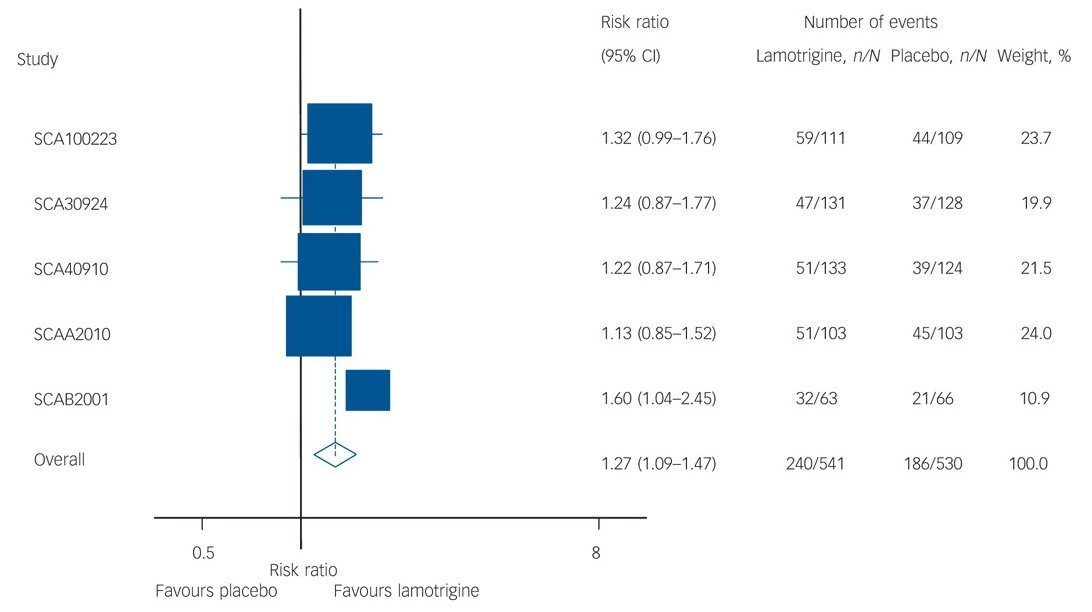 |
| Figure 1. Figure from Geddes et al - Meta-analysis of HRSD 50% response rates using individual patient data from GSK trials |
The response rates in this study are around 35% of patients in the placebo arm and 45% of those taking lamotrigine - so an increase of 10 percentage points due to lamotrigine. If we consider that, for the average patient, 50% improvement implies a minimum change of around 12 points on the HRSD the actual mean improvement of 1.0 points (and the standard deviation) seems a little small (in a back of the envelope calculation you could say that you would expect an average of 1.2 point improvement - thats 10% getting 12 points averaged over all the group). So a bit of a mixed bag I'd say.
Traditional meta-analysis versus individual patient data
A question that occurs to me is what extra information we gain from having the individual patient data? It is pretty rare to get hold of individual patient data when doing a meta-analysis, usually all we have is the overall results for each trial. Sometimes this doesn't make much difference, comparing the individual level meta-analysis by Fournier et al of antidepressants with Kirsch et al's meta-analysis did not reveal any major differences (and these studies looked at fairly different sets of antidepressants).
I had a quick go at performing a study level meta-analysis of the GSK lamotrigine data** and found that the response rate had a relative risk of 1.22 (1.06-1.41) (Figure 2 below) which is pretty similar to the individual level data 1.27 risk ratio.
 |
| Figure 2. Meta-analysis of HRSD 50% response rates from GSK per trial data |
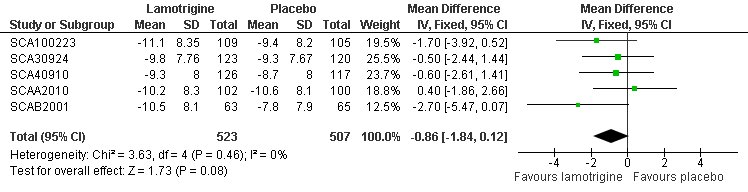 |
| Figure 3. Meta-analysis of mean difference in HRSD scores from GSK per trial data |
Antidepressant response and the severity of depression
Like many previous studies of antidepressants Geddes et al also find that there is an interaction between the size of the antidepressant effect of lamotrigine and how severely depressed the patients in the study were at baseline. They found a significant interaction on their ANCOVA analysis between baseline HRSD severity and final HRSD score with a regression coefficient of .30 (p=.04). They go on to comment that:
"Thus, the interaction by severity was because of a higher response rate in the moderately ill placebo-treated group, rather than, for example, a higher response rate in the severely ill lamotrigine-treated group."This statement is very redolent of Kirsch et al's claim:
"The relationship between initial severity and antidepressant efficacy is attributable to decreased responsiveness to placebo among very severely depressed patients, rather than to increased responsiveness to medication."Kirsch et al got a lot of stick for saying this, not least from yours truly, so I was interested in what a set of rather more mainstream figures in the psychiatric world (two Oxford academic psychiatrists and a psychiatrist from the GSK advisory board) were trying to say, and how this relates the Kirsch's work. Maybe I was being unfair to Kirsch?
Kirsch et al argued that the apparent increase in antidepressant efficacy with increasing baseline severity in trials was due to decreasing placebo response in more severe trials (see Figure 4 below). They further argued that this increasing efficacy was therefore only 'apparent' because the response to antidepressant was the same. I've discussed before how, on many levels, it is meaningless to claim that this effect is only 'apparent'.
 |
| Figure 4. Figure from Kirsch et al - Regression of baseline severity against standardised mean difference of HRSD score improvement for antidepressant and placebo groups using per trial data |
 |
| Figure 5. Regression of baseline severity against HRSD score improvement for antidepressant and placebo groups using per trial data from Kirsch et al |
 |
| Figure 6. Figure from Fournier et al - Regression of baseline severity against HRSD score improvement for antidepressant and placebo groups using individual patient data |
So what did Geddes et al find? Well, unlike Kirsch et al and Fournier et al they primarily looked at response rates rather than mean change in HRSD, obviously you can't have an individual patient's response rate (an individual either does, or does not respond) so they divided the subjects into two groups, those with a baseline severity below 24 points, and those above. They found that only those in the 'severe' severity (>24 point) group had a statistically significant response rate greater than placebo with 46% of those on lamotrigine responding compared to 30% on placebo. In the 'moderate' (<= 24 point) group response rates were 48% for lamotrigine and 45% for placebo. Geddes and others have argued that this increased placebo response at moderate severity is due to something like inflation of baseline severity at trial recruitment (that is doctors subconsciously inflate severity for those around the lower threshold for trial recruitment and they then regress to the 'real' lower score they would have had anyway when assessed blindly as part of the trial while this doesn't happen for the more severe patients).***
Now I've outlined some of my reservations about 50% reduction in HRSD score as a measure of 'response rate' and I don't think that these numbers necessarily show what Geddes et al think it does. Let's consider a simple model of how antidepressants might work, let's say they can be modelled simply by saying that an antidepressant reduces the baseline HRSD score by X HRSD points which is the simple sum of the placebo effect (P) and a 'true' antidepressant effect (A):
X = P + A
Based on this model, as discussed above, we can see how patients in the 'moderate' severity group could be more likely to respond even if X is the same for both severity groups. This is because a lower baseline severity means less HRSD points need to be lost to reach a 50% reduction. If we take this observation it is conceivable that the lower placebo response in the 'severe' group could be, at least partly, due to pure artefact. Given that those treated with lamotrigine in the 'severe' group had a larger response rate than those on placebo you might then go on to posit that maybe P is larger for the more severely depressed patients.
The way we ideally would want to answer this question would be to look at the mean HRSD scores as we did above for the data from Kirsch et al and Fournier et al. The response rate figures alone would still be completely consistent with a relationship like that shown in Figure 5 above and suggest that the claim that "the interaction by severity was because of a higher response rate in the moderately ill placebo-treated group" is false.
Unfortunately Geddes et al don't show the mean HRSD data by baseline severity nor do they report the correlations between mean HRSD score and baseline severity for the lamotrigine and placebo groups separately, either of which might help to answer this question. This is a bit odd as this is one of the main areas where the individual patient data would prove very useful and answer questions that the trial only data cannot. So we'll never know whether they do or don't show that placebo responses are constant, decreased, or increased with greater severity of depression. I've reproduced the data presenting each trial below (Figures 7 & 8) but these can't really answer this question, for that we need the within trial data.
 |
| Figure 7. Simple regression of mean baseline severity against 50% response rates from GSK per trial data split by lamotrigine (blue) and placebo (red) |
 |
| Figure 8. Simple regression of mean baseline severity against mean change in HRSD score from GSK per trial data split by lamotrigine (blue) and placebo (red) |
Summary
So, what should we conclude? Well a few things:
- Lamotrigine is not very effective for acute bipolar depression
- Individual patient data in these trials doesn't tell us much more than a classical meta-analysis
- The effect of lamotrigine, like other antidepressants in major depression, increases with greater baseline severity of depression, but never reaches the NICE 'clinical significance' criteria
- It is unclear exactly why antidepressant efficacy increases in this way but it is far from established that it is due to "higher response rate in the moderately ill placebo-treated [patients], rather than, for example, a higher response rate in the severely ill lamotrigine-treated [patients]"
So what next?
So what medication should be used for acute treatment of bipolar depression? Well I think the data from quetiapine is pretty promising and certainly a lot more convincing and impressive than for lamotrigine monotherapy. Perhaps lamotrigine will be synergistic when added to quetiapine and the first author, John Geddes, is heading up the CEQUEL trial looking at just this question.
* I think a better measure might be a fixed improvement in HRSD score, call it a 'clinically significant response', this would avoid the assumption that antidepressants somehow cause an X% reduction in HRSD score rather than say improving Y number of symptoms, and thus the problem I've mentioned above about how mildly depressed patients need less improvement to 'respond' than more severely depressed.
** I got the response rate data from the Geddes et al paper and the HRSD mean difference data from the GSK trials register (since it wasn't presented in the paper). I used mean change scores rather than final HRSD scores (although this shouldn't make much difference), I had to estimate standard deviations for trial SCA40910 and the means for trial SCA30924 were already adjusted for baseline severity. Data are for fixed effect models but random effects makes minimal difference to the results.
*** Interestingly this explanation would only be tenable if trials of greater severity showed the same within-trial effect as trials of lower severity, since this effect should take place at the recruitment threshold irrespective of what that threshold is. So therefore within a trial the less severe subjects around the recruitment threshold should show a greater placebo response whereas there would not necessarily be any relationship between average baseline severity and average response between trials. This means that my regression data from Figure 5 above doesn't necessarily argue against this model - what we need to know is whether this relationship holds within the trials, something that even the individual subject data from Figure 6 doesn't rule out because we'd ideally have data separately plotted for each trial since the recruitment thresholds for each trial may have differed.
Friday, 13 August 2010
Depression severity
Interesting post on neuroskeptic about the HAMD:
"The APA use the terminology "Very Severe", which doesn't even appear on other scales...But where did the APA get their system from? This is the most extraordinary thing. Here's the paper they based their approach on. It's an 1982 British study by Kearns et al...You'll recognize the APA's categories, kind of, but they're all shifted. Why? We can only guess. Here's my guess. The scores in that Kearns et al graph were the average HAMD scores of people who fell into each severity band. The APA must have decided that they could use these to create cutoffs for severity."
Tuesday, 30 March 2010
Serotonin hypothesis of depression
A post from The Twenty-First Floor on the serotonin hypothesis of depression:
The main aetiological explanation for depression in the public consciousness is undoubtedly the “serotonin hypothesis”. This probably manifests more popularly as the idea that depression is somehow the result of a “chemical imbalance” in the brain, and therefore that sufferers of depression (whose suffering is not in question) are somehow the passive victims of an organic condition, like victims of diabetes, for example, and that this can be righted with medication. It’s a neat explanation, which, I guess, is why it’s so appealing. However, the evidence, as it so often does, suggests that depression is nowhere near this simple.While I agree that the evidence for the serotonin hypothesis of depression (or even the rather wider monoamine hypothesis) is fairly weak, he links to this study finding mixed evidence for an association between suicide, impulsivity, and depression and serotonin metabolite levels. It is worth noting that a review by Mann et al (1989) is often taken as demonstrating that serotonin (or its metabolites) are reduced in the brainstem (source of serotonergic projections in the brain) in suicides, independent of underlying diagnosis. Although this actually only shows reduced serotonin in depressed suicides (if you look at the individual studies) that would actually make it stronger evidence for the hypothesis.
Saturday, 14 November 2009
Are glutamatergic drugs the future for the treatment of schizophrenia?
Just found this on my PC, I wrote it some time ago, before the latest news on the failure of the LY2140023 trial was known (I altered it a little around the time to reflect this). I started it with the intention of doing an updated meta-analysis of glutamatergic drugs in schizophrenia but it became apparent that the quality of the data was so low that I wasn't going to be able to carry out any sensible analysis. I wrote the following as a summary of what I'd wasted my time doing, it isn't really publishable quality but I thought people might be interested if psychiatry is their area (I could have put it on a pre-print server like Nature Precedings but they don't like clinical treatment data).
Abstract
There is growing evidence for the role of glutamate in the aetiology of schizophrenia and a number of glutamatergic drugs are being developed and trialled. This systematic review finds that there is evidence for beneficial effects on symptoms in schizophrenia for both adjuvant NMDA glycine binding-site agonists and monotherapy with a type II metabotropic glutamate receptor agonist (LY2140023). LY2140023 represents the first successful placebo controlled clinical trial of non-dopamine based antipsychotic therapy for schizophrenia but the evidence for its greater efficacy over glycine binding-site agonists is tentative at best. It is unclear why the apparently antagonistic effects of post-synaptic NMDA co-agonism and reduced glutamate release via pre-synaptic inhibition from type II metabotropic agonism both appear to have beneficial effects on schizophrenic symptoms, nor why the latter is so much more successful than direct NMDA antagonism. Ongoing trials should help to clarify the promising results found to date.Introduction
All existing antipsychotics work via the dopamine D2 receptor (1) but this class of medication has several important limitations. Although effective at treating ‘positive’ symptoms of schizophrenia (such as hallucinations and delusions) antipsychotics have limited impact on ‘negative’ symptoms (such as emotional blunting) or cognitive deficits, and it is these that are thought to have most relevance for prognosis (2). Side-effects are significant and range from considerable weight gain and hyperprolactinaemia to movement disorders such as extra-pyramidal effects and tardive dyskinesia. Although clozapine, and the atypical antipsychotics have been considered superior to typical antipsychotics any advantages appear to be fairly marginal (3).While pathophysiological investigations of schizophrenia have traditionally concentrated on the dopaminergic system (4, 5) there is increasing evidence from gene association and neuropathological studies for an involvement of the glutamatergic system (6). For some time there have been hopes that medications which interact with the glutamatergic system may be able to ameliorate some of the negative and cognitive deficits of schizophrenia. In this review I appraise the current clinical evidence in a narrative systematic review of double blind randomised controlled clinical trials of adjuvant or monotherapy with glutamatergic drugs in schizophrenia.
Methods
Glutamatergic drugs were defined as those primarily acting via glutamate receptors or the glutamatergic system (e.g. re-uptake inhibition). Medline was searched via PubMed using the ‘broad’ and ‘therapy’ clinical study filters and the Cochrane Central Register of Controlled Trials (CENTRAL) was also searched up to January 2009. Search terms were ‘schizophrenia’ AND either ‘glutamate*’ or the names of specific glutamatergic compounds discussed below (glycine, d-cycloserine etc.). Unpublished trials from the CENTRAL database were not included in the results because no data was available, this may produce a degree of publication bias in the studies considered. Following from previous reviews I concentrate on overall symptoms as determined by the Positive and Negative Syndrome Scale (PANSS) or the Brief Psychiatric Rating Scale (BPRS), negative symptoms as determined by the PANSS negative subscale or the Scale for the Assessment of Negative Symptoms (SANS), and positive, cognitive, and general symptoms from the relevant PANSS subscales.Results
Searches produced 522 records from Medline and 102 records from CENTRAL with 18 trials previously covered by a Cochrane review and a further 18 new studies identified. Trials were generally of good quality although small in size and of short duration. Reporting of blinding methods was poor, and outcome measures and statistical methodology were well validated but varied between trials making comparisons difficult. The initial goal to perform a meta-analysis using the additional data from newly identified studies was abandoned due to the difficulty in extracting usable data. All trials mentioned in this review are placebo controlled unless stated otherwise.Glutamatergic stimulation
One model for pathology in schizophrenia is a hypoglutamatergic state or N-methyl-d-aspartate (NMDA) receptor dysfunction. Consistent with this proposal blockade of the NMDA receptor with phencyclidine or ketamine produces a psychotic syndrome similar to schizophrenia, including negative and cognitive symptoms. In pre-clinical trials, the use of co-agonists at the glycine binding-site of the NMDA receptor has been shown to modify some of the effects of NMDA antagonism (7).The genes G72 and d-amino acid oxidase (DAAO) have been implicated in the genetics of schizophrenia (8) and are involved directly in neurotransmission at the NMDA receptor glycine binding-site, with DAAO metabolising the endogenous agonist d-serine.
These findings suggest that glycine binding-site agonists may potentially act to facilitate NMDA neurotransmission and correct underlying glutamate hypofunction in schizophrenia.
Adjuvant therapy
There have been a number of reports that augmentation of antipsychotics with agonists at the glycine binding-site preferentially improve negative and cognitive symptoms (7). A Cochrane Review has looked at the endogenous agonists glycine and d-serine and the partial agonist d-cycloserine as adjuvant therapy in schizophrenia (9). From data published up to 2003 they found 18 double blind randomised controlled trials, all short (≤12 weeks) with small numbers (358 subjects randomised in total).
d-cycloserine appeared to be ineffective on all measures, with trends towards harm compared to placebo. Glycine and d-serine were effective on some global measures and symptom scores. These comparisons all involved few patients (<150)>
Three further adjuvant studies of daily d-cycloserine have since been published and none of these found a beneficial effect on symptoms confirming the negative findings from the Cochrane review (10-12). However, an 8-week study of once weekly d-cycloserine adjuvant therapy in 38 patients found a statistically significant effect on mean negative scores but not 20% improvement rates or mean positive or cognitive scores (13).
Several studies of full glycine binding-site agonists have also been published since the Cochrane review. A 16-week trial, with 104 patients in the glycine and placebo groups combined, looking at adjunctive glycine found no difference from placebo for mean difference or 20% improvement in negative symptom scores, or for mean differences in cognitive or positive symptom scores (12). Conversely, a cross-over study of 17 patients using high dose glycine added to atypical antipsychotics resulted in a significant decrease in mean negative, cognitive, and positive symptom scores at 6-weeks. There was not a significant increase in 20% improvement rates for overall symptoms but there was for negative symptoms (14).
Similarly, in a cross-over study of 39 patients with adjuvant d-serine and atypical antipsychotics there was a significant decrease in mean negative, cognitive, and positive symptom scores, and also extra-pyramidal side-effects at 6-weeks, with 20% improvement rates significant for overall symptoms and negative symptoms (15). However, in a trial of d-serine added to risperidone, with 44 patients with acute exacerbations of schizophrenia in the d-serine and placebo groups combined, there was no statistically significant mean difference in overall or negative symptom scores at 6-weeks (16). Another small cross-over trial of 12 patients on clozapine also found no difference in mean overall, negative, positive, or general scores at 12-weeks (17).
Finally, d-alanine, another glycine binding-site agonist, has been tested as a adjuvant therapy in a 6-week study of 32 patients which found a significant benefit in mean scores on overall, negative, positive, and cognitive symptom scales (18).
The Cochrane review and later studies suggests that the partial agonist d-cycloserine is ineffective as adjuvant treatment in schizophrenia but the balance of evidence is still equivocal for the full glycine binding-site agonists. A reasonable estimate of the NNT for a 20% improvement in symptoms would be of the order of five patients but there is an obvious need for better and more consistent reporting to facilitate comparisons between trials and meta-analysis, particularly for cross-over trials. From the evidence these drugs appear to be well tolerated but they are not very practical to use, requiring fairly high doses diluted in liquid. Most trials have been fairly short, except for one 6 month trial of d-cycloserine, so estimates of long-term efficacy and tolerability are needed.
An alternative method of promoting agonist activity at the glycine binding site is the use of glycine re-uptake inhibitors. The glycine transporter-1 inhibitor N-methyl-glycine (sarcosine) has been examined in three studies. A 6-week trial of sarcosine with 38 patients showed benefits on mean differences in overall, negative, positive, cognitive, and general symptoms. These results were dependent on the analysis method, but mean differences at 6 weeks appear robust for overall and general symptoms (19).
Another 6-week study of sarcosine added to risperidone in acute exacerbations of schizophrenia, with 44 patients in the sarcosine and placebo arms combined, found significant changes in mean overall, negative, cognitive, and general symptom scales (although these depended on the analysis method used), with a significant difference in the rates of clinical response (defined as a 30% reduction in overall symptoms) (16). However, in a 6-week study of sarcosine added to clozapine with 20 patients there was no significant effect on mean difference in overall, negative, positive, cognitive, or general symptom scales (20). Pooling 6-week mean differences from all three studies will not result in significant effects because the statistical differences in the original studies largely depends on using regression to control for baseline imbalance in severity.
There has been some suggestion that use of glycine agonists with clozapine results in lower efficacy, perhaps because clozapine already has some glutamatergic activity. The Cochrane review found no evidence of differential efficacy of these drugs when used with typical or atypical antipsychotics, or with clozapine, and later studies have not provided any strong evidence to contradict this finding.
The compound CX516 is an ‘AMPAkine’ and allosterically binds to the ionotropic α-amino-3-hydroxy-5-methylisoxazole-4-propionic acid (AMPA) receptor prolonging channel opening. It has been studied as an adjuvant therapy in schizophrenia with no significant benefit found in mean overall, negative, positive, cognitive, or general symptom scales (21, 22). A tiny trial of eight patients also failed to find evidence of benefit for CX516 as monotherapy (23).
Monotherapy
Recently a small trial of 20 patients was published looking at 6-weeks of sarcosine monotherapy for acute exacerbation of schizophrenia. This was not placebo controlled but rather compared high and low doses of sarcosine. There were no significant benefits of a higher dose on mean overall, negative, positive, or general symptom scales, but on the dichotomous outcome of 20% improvement in overall symptom score there was a significant benefit over the lower dose, and this was found in those subjects who were antipsychotic naïve (24). Although the dichotomous data suggests a NNT under three patients, in the absence of a change in mean symptom scores it seems unlikely that this finding reflects a true clinical benefit.
Glutamatergic inhibition
In contrast to the above proposition that glutamate hypofunction contributes to the symptomatology of schizophrenia, there has been some suggestion that glutamate hyperfunction may also play a role. Although superficially contradictory there is evidence that NMDA receptor hypofunction preferentially affects inhibitory interneurons causing disinhibition of pyramidal cells and increased glutamate release in prefrontal cortex (25).
Adjuvant therapy
Given the known effects of NMDA receptor antagonists such as phencyclidine in producing psychotic symptoms there has been little focus on these drugs as therapy. However, memantine is an NMDA antagonist used for the treatment of the cognitive symptoms of Alzheimer’s disease and has been investigated in an 8-week clinical trial of 138 patients as an adjunct to atypical antipsychotics. This study found no significant effect of memantine on global scores, or on overall, positive, negative, or cognitive symptom scales (26). There was also no significant difference in response rates (10% reduction in overall symptom score) but an increased rate of adverse events, including 6% of patients experiencing auditory hallucinations. Another study published only in abstract form has also found no effect of adjunctive memantine on cognitive measures (27).
Monotherapy
In 2007 a glutamate agonist trial was published that caused some considerable interest. This was a 4-week trial of 196 patients with poorly controlled chronic schizophrenia given the compound LY2140023 (versus olanzapine or placebo) (28). LY2140023 is metabolised to LY404039, a selective agonist at metabotropic mGluR2/3 glutamate receptors. The gene for mGluR3 has previously been associated with schizophrenia (6). As an agonist at type II metabotropic autoreceptors LY2140023 would be expected to antagonise rather than potentiate glutamate transmission, a mechanism that contrasts with the NMDA glycine binding-site agonists. However, LY2140023 has been shown to ameliorate the effects of NMDA antagonists in pre-clinical studies. Significant reductions were seen in mean overall, negative, and positive symptom scores for both LY2140023 and olanzapine, but LY2140023 did not show the weight gain associated with olanzapine. The reduction in symptom scores was greater for olanzapine than LY2140023, particularly with positive symptoms, but this difference was not statistically significant. With the dichotomous outcome of improvement (25% reduction) in overall symptoms there was a significant benefit to both LY2140023 and olanzapine compared to placebo suggesting a NNT of less than three patients for olanzapine and around 3.5 for LY2140023.
It is worth noting that while commentators have been quick to hail the advent of a new antipsychotic agent without the extra-pyramidal side-effects of dopamine blockade this study did not find any evidence for a difference using a variety of rating scales for these side-effects, although there was a significant difference in prolactin levels between the two drug groups. A substantial number of patients dropped out of the study (40%, primarily due to lack of efficacy), significantly more in the placebo group although the LY2140023 group also had more dropouts than the olanzapine group.
Discussion
The study of LY2140023 represents the first successful placebo controlled clinical trial of non-dopamine based antipsychotic therapy for schizophrenia* and the results suggest that this and similar compounds represent a promising avenue for developing antipsychotics with a different side-effect profile to that of current medication and the potential for efficacy in patients resistant to current treatments. This study does not establish that LY2140023 is better than olanzapine for negative symptoms, an early hope for these compounds, nor that it has a lower incidence of extra-pyramidal symptoms (since there were few of these in this short study) although prolactin levels were lower and weight gain less. There is an outstanding issue regarding the optimum dosing regime with LY2140023 and it is possible that higher doses could result in a greater antipsychotic effect and more marked effect on negative symptoms. A dosing study has just been completed but the manufacturers have recently announced that this failed to show a benefit of LY2140023 over placebo with no dose response effect – this failure has been ascribed to the large placebo response in the trial and further studies are awaited with interest.
It is worth comparing the NNT in the 2007 LY2140023 study with the evidence from glycine binding-site agonists as adjuvant treatment. The Cochrane review found a NNT for 20% reduction in symptoms of three patients (including evidence from later studies a more reasonable estimate would be five) and high dose sarcosine monotherapy produced a NNT of less than three patients (compared to a low dose of sarcosine). These effects are not markedly dissimilar to the results of LY2140023 and mean differences in negative symptom scales (the main outcome used in the adjuvant studies) for glycine binding-site agonists are of a similar magnitude to LY2140023. However, the difference in mean overall symptom scores is much larger for LY2140023 than the glycine binding-site agonists, and the sarcosine monotherapy trial produced no significant differences in mean symptom scores at all.
These comparisons suggest that, while LY2140023 has evidence for somewhat greater efficacy than glycine binding-site agonists this is a tentative conclusion at best, and may prove to be premature when the results of the latest trial of LY2140023 are published. We are still awaiting the outcome of placebo controlled trials of glycine binding-site agonists as monotherapy, but it is conceivable that use as adjuvant therapy may have underestimated the full antipsychotic effect of these compounds. Similarly, trials of LY2140023 as an adjuvant therapy may show an additive therapeutic benefit over-and-above the effect of conventional antipsychotics, which may be similar to or greater than that of the glycine binding-site agonists.
It is not entirely clear why both NMDA glycine binding-site agonism and reduced glutamate release (via type II metabotropic receptor agonism) appear to have beneficial effects on schizophrenic symptoms, nor why the latter is so much more successful than direct NMDA antagonism. Presumably differential and complex effects on neural circuits underlie this apparent paradox but it highlights how poor our understanding of the glutamatergic pathology of schizophrenia still is. Glutamatergic drugs may still not prove to be the future of schizophrenia treatment, but they are currently offering some hope.
References
* Although the original study found no evidence that LY2140023 or LY404039 interact with dopamine receptors it has been proposed that there may be some action at high-affinity state dopamine D2 receptors (29), and there are considerable interactions between the glutamatergic and dopaminergic systems (6).
1. Seeman P, Chau-Wong M, Tedesco J, Wong K. Brain receptors for antipsychotic drugs and dopamine: direct binding assays. Proc Natl Acad Sci U S A 1975;72(11):4376-80.
2. Green MF. What are the functional consequences of neurocognitive deficits in schizophrenia? Am J Psychiatry 1996;153(3):321-30.
3. Tandon R, Belmaker RH, Gattaz WF, Lopez-Ibor JJ, Jr., Okasha A, Singh B, et al. World Psychiatric Association Pharmacopsychiatry Section statement on comparative effectiveness of antipsychotics in the treatment of schizophrenia. Schizophr Res 2008;100(1-3):20-38.
4. Weinberger DR. Implications of normal brain development for the pathogenesis of schizophrenia. Arch Gen Psychiatry 1987;44(7):660-9.
5. Matthysse S. Antipsychotic drug actions: a clue to the neuropathology of schizophrenia? Fed Proc 1973;32(2):200-5.
6. Harrison PJ, Weinberger DR. Schizophrenia genes, gene expression, and neuropathology: on the matter of their convergence. Mol Psychiatry 2005;10(1):40-68.
7. Javitt DC. Glutamate as a therapeutic target in psychiatric disorders. Mol Psychiatry 2004;9(11):984-97, 979.
8. Li D, He L. G72/G30 genes and schizophrenia: a systematic meta-analysis of association studies. Genetics 2007;175(2):917-22.
9. Tuominen HJ, Tiihonen J, Wahlbeck K. Glutamatergic drugs for schizophrenia. Cochrane Database Syst Rev 2006(2):CD003730.
10. Duncan EJ, Szilagyi S, Schwartz MP, Bugarski-Kirola D, Kunzova A, Negi S, et al. Effects of D-cycloserine on negative symptoms in schizophrenia. Schizophr Res 2004;71(2-3):239-48.
11. Goff DC, Herz L, Posever T, Shih V, Tsai G, Henderson DC, et al. A six-month, placebo-controlled trial of D-cycloserine co-administered with conventional antipsychotics in schizophrenia patients. Psychopharmacology (Berl) 2005;179(1):144-50.
12. Buchanan RW, Javitt DC, Marder SR, Schooler NR, Gold JM, McMahon RP, et al. The Cognitive and Negative Symptoms in Schizophrenia Trial (CONSIST): the efficacy of glutamatergic agents for negative symptoms and cognitive impairments. Am J Psychiatry 2007;164(10):1593-602.
13. Goff DC, Cather C, Gottlieb JD, Evins AE, Walsh J, Raeke L, et al. Once-weekly D-cycloserine effects on negative symptoms and cognition in schizophrenia: an exploratory study. Schizophr Res 2008;106(2-3):320-7.
14. Heresco-Levy U, Ermilov M, Lichtenberg P, Bar G, Javitt DC. High-dose glycine added to olanzapine and risperidone for the treatment of schizophrenia. Biol Psychiatry 2004;55(2):165-71.
15. Heresco-Levy U, Javitt DC, Ebstein R, Vass A, Lichtenberg P, Bar G, et al. D-serine efficacy as add-on pharmacotherapy to risperidone and olanzapine for treatment-refractory schizophrenia. Biol Psychiatry 2005;57(6):577-85.
16. Lane HY, Chang YC, Liu YC, Chiu CC, Tsai GE. Sarcosine or D-serine add-on treatment for acute exacerbation of schizophrenia: a randomized, double-blind, placebo-controlled study. Arch Gen Psychiatry 2005;62(11):1196-204.
17. Diaz P, Bhaskara S, Dursun SM, Deakin B. Double-blind, placebo-controlled, crossover trial of clozapine plus glycine in refractory schizophrenia negative results. J Clin Psychopharmacol 2005;25(3):277-8.
18. Tsai GE, Yang P, Chang YC, Chong MY. D-alanine added to antipsychotics for the treatment of schizophrenia. Biol Psychiatry 2006;59(3):230-4.
19. Tsai G, Lane HY, Yang P, Chong MY, Lange N. Glycine transporter I inhibitor, N-methylglycine (sarcosine), added to antipsychotics for the treatment of schizophrenia. Biol Psychiatry 2004;55(5):452-6.
20. Lane HY, Huang CL, Wu PL, Liu YC, Chang YC, Lin PY, et al. Glycine transporter I inhibitor, N-methylglycine (sarcosine), added to clozapine for the treatment of schizophrenia. Biol Psychiatry 2006;60(6):645-9.
21. Goff DC, Leahy L, Berman I, Posever T, Herz L, Leon AC, et al. A placebo-controlled pilot study of the ampakine CX516 added to clozapine in schizophrenia. J Clin Psychopharmacol 2001;21(5):484-7.
22. Goff DC, Lamberti JS, Leon AC, Green MF, Miller AL, Patel J, et al. A placebo-controlled add-on trial of the Ampakine, CX516, for cognitive deficits in schizophrenia. Neuropsychopharmacology 2008;33(3):465-72.
23. Marenco S, Egan MF, Goldberg TE, Knable MB, McClure RK, Winterer G, et al. Preliminary experience with an ampakine (CX516) as a single agent for the treatment of schizophrenia: a case series. Schizophr Res 2002;57(2-3):221-6.
24. Lane HY, Liu YC, Huang CL, Chang YC, Liau CH, Perng CH, et al. Sarcosine (N-methylglycine) treatment for acute schizophrenia: a randomized, double-blind study. Biol Psychiatry 2008;63(1):9-12.
25. Homayoun H, Moghaddam B. NMDA receptor hypofunction produces opposite effects on prefrontal cortex interneurons and pyramidal neurons. J Neurosci 2007;27(43):11496-500.
26. Lieberman JA, Papadakis K, Csernansky J, Litman R, Volavka J, Jia XD, et al. A Randomized, Placebo-Controlled Study of Memantine as Adjunctive Treatment in Patients with Schizophrenia. Neuropsychopharmacology 2008.
27. Lee JG, Kim Y-H, Lee SW. Adjunctive memantine therapy for cognitive impairment in chronic schizophrenia: A 12-week, double-blind, placebo-controlled trial (abstract). International Journal of Neuropsychopharmacology 2008;11(Suppl 1):141-2.
28. Patil ST, Zhang L, Martenyi F, Lowe SL, Jackson KA, Andreev BV, et al. Activation of mGlu2/3 receptors as a new approach to treat schizophrenia: a randomized Phase 2 clinical trial. Nat Med 2007;13(9):1102-7.
29. Seeman P. Glutamate agonists for schizophrenia stimulate dopamine D2High receptors. Schizophr Res 2008;99(1-3):373-4.
Subscribe to:
Posts (Atom)